(20th March 2013 – 14½ mile walk from Kirkby Stephen to Keld via Nine Standards Rigg)
For once it wasn’t snowing when I woke and looked out of my bedroom window … though more snow was forecast.
Despite a good night sleep, I was tired. Progress on the C2C had been tough and over the previous five days, I had covered 92.5 miles – with a heavy ruck sack. But today, dear reader, today I would be taking it easy. Today I would finally enjoy my much anticipated ‘rest’ day. Not a rest day from walking altogether but a more restful day by taking the quickest, easiest march to Keld. Pat concurred and we decided to avoid the peat bog crossing of the Pennines altogether and follow the B6270 road. This is what Wainwright suggests if visibility on the tops is poor.
We thought it sage advice.
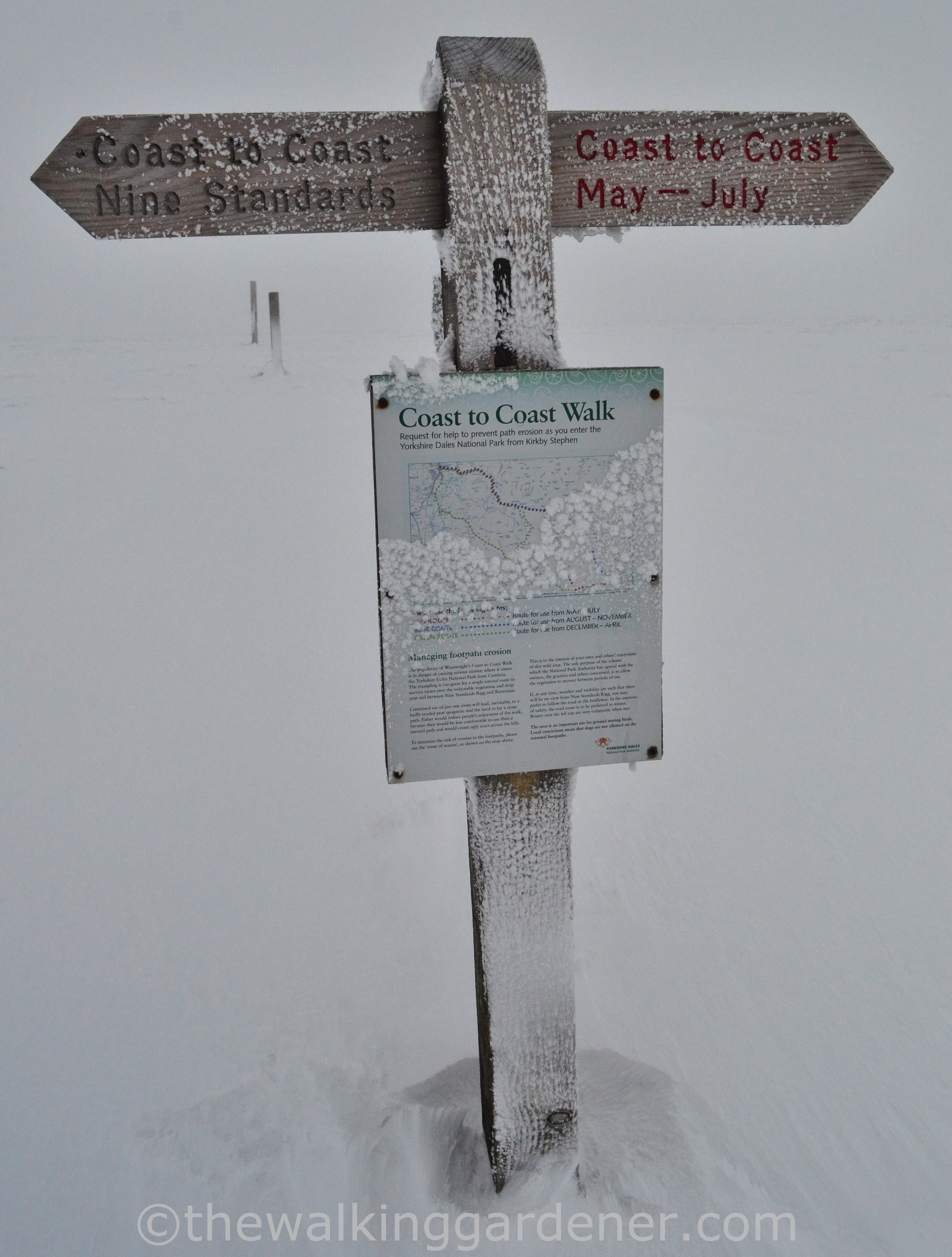
The Coast to Coast between Kirkby Stephen and Keld climbs up to the curious stone cairns of Nine Standards Rigg, before descending again across tracts of peat bog to the village. Depending on the time of year, there is a choice of three paths over the moors:
Red Route – May to July
Blue Route – August to November
Green Route – December to April
Given the time of year, Pat and I did consider taking the Green Route before dismissing the idea completely and deciding on none of the above but on unromantic tarmac instead.
Pause.
But then. Oh, but then, during breakfast, my B&B owner (at the very comfortable ‘Old Croft‘ – great breakfast, great packed lunch,
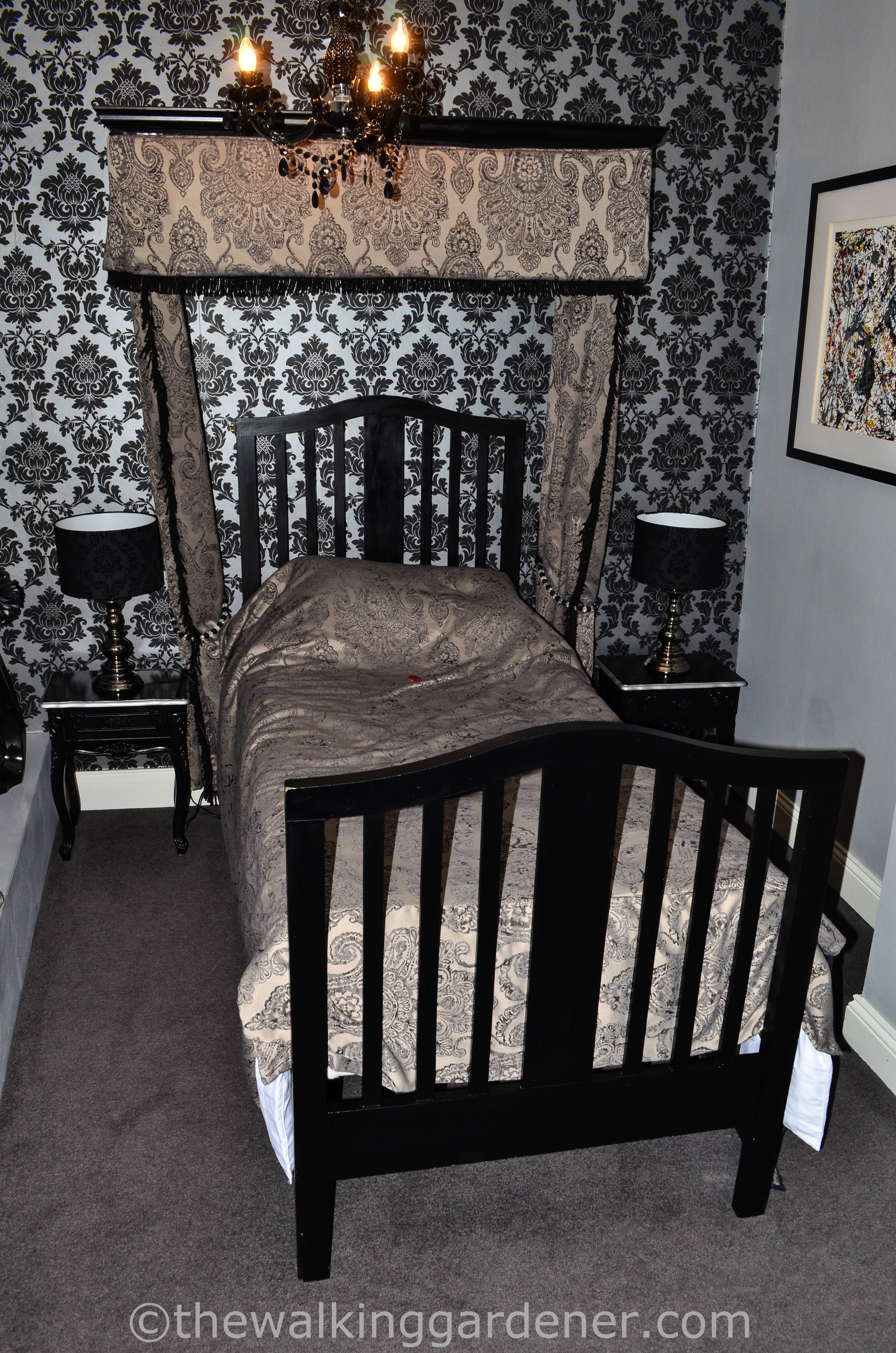
room decor perhaps a little too Gothic Princess) advised that the Blue route, rather than the more obvious Green, would be perfectly do-able. And shortly after setting off, we chatted to a friendly local who gave the same Blue advice. Against our better judgement, and a little rashly, we decided to ditch the easy tarmac day plan and climb up and over the moors after all.
I’m very glad that we did; today was one of the most memorable of Wainwright’s Coast to Coast. But an easy rest day? Nah, it wasn’t that.
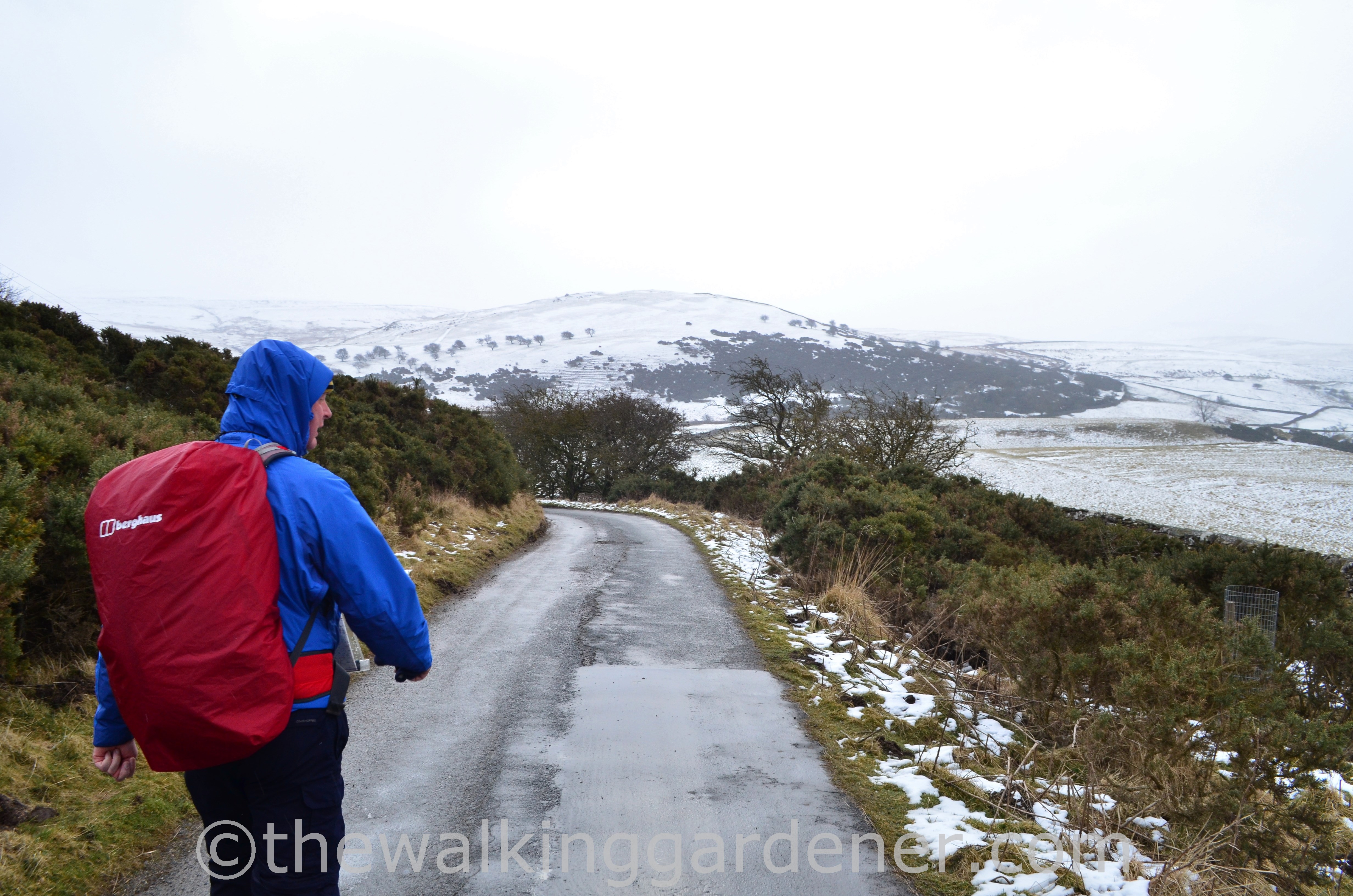
As we left the town, the sun shone briefly but by the time we were on the small road beyond Hartley, cloud swung in and it quickly turned bitterly cold. Again.
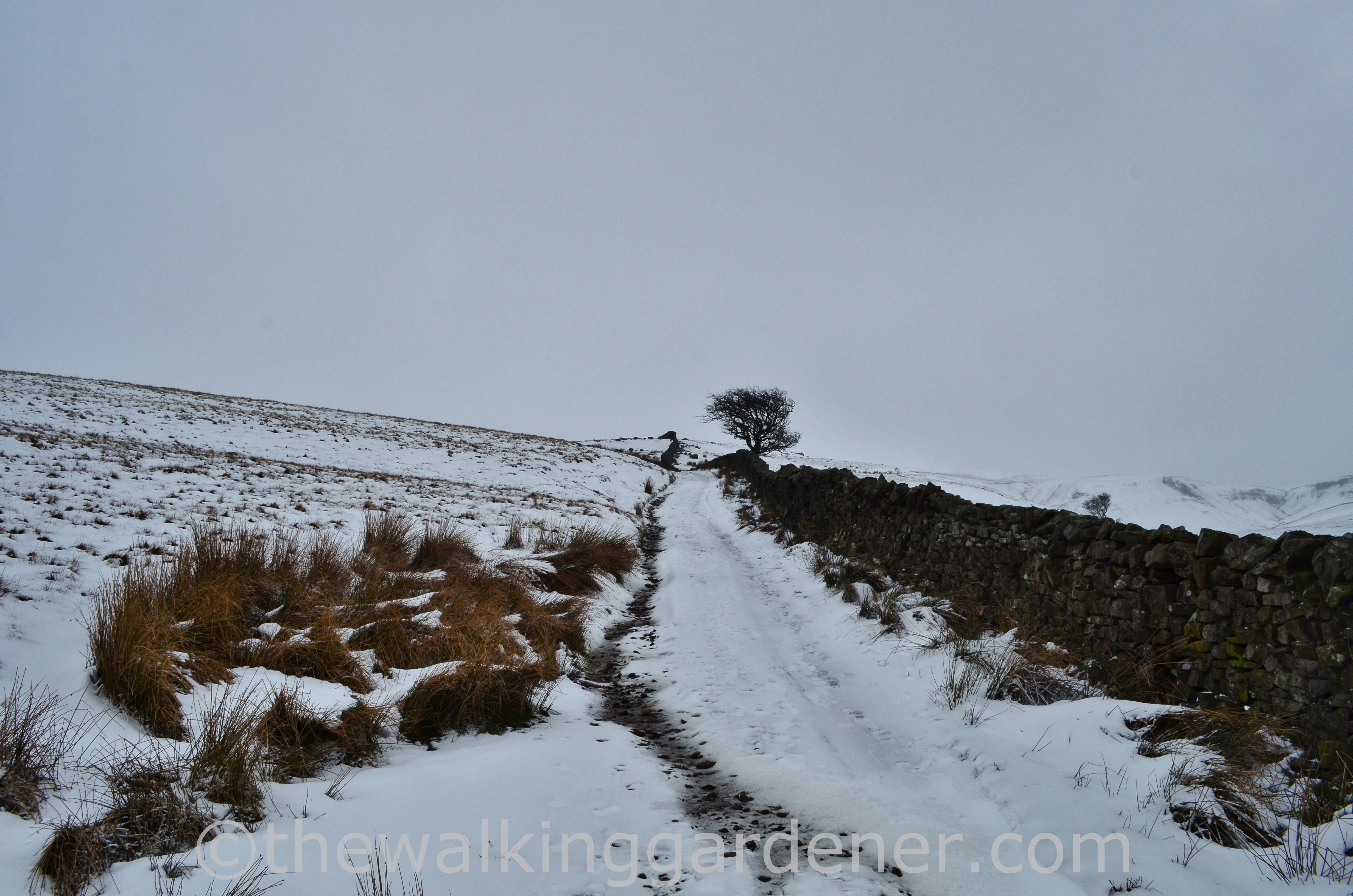
Continuing the long 2172 ft climb, we were hit full on by that wind. That freezing easterly that had been our bane and battered us for the past two days. It was a hard plod, pushing into that wind.
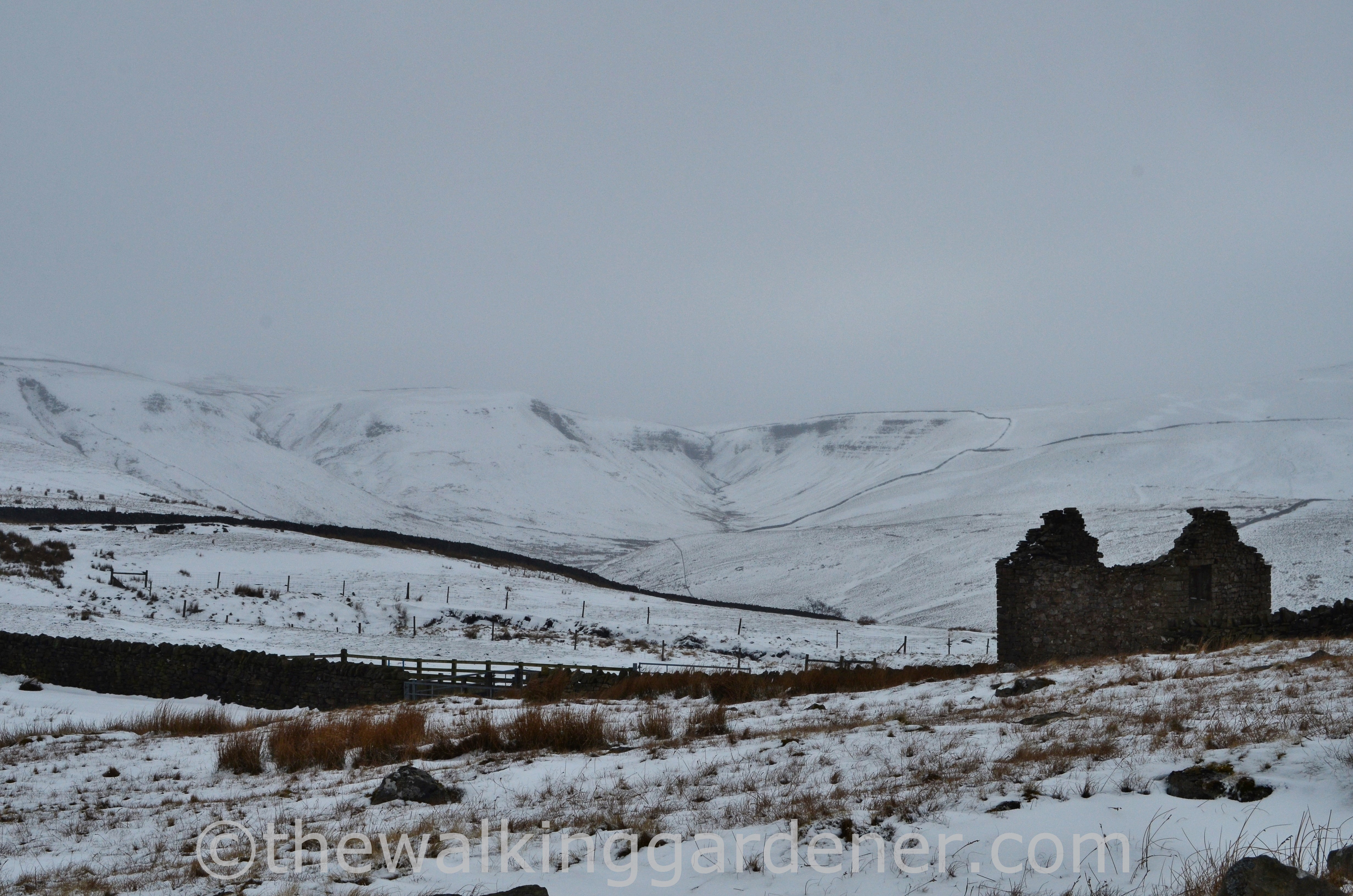
I don’t know the Pennines particularly well but I do love their brutal, don’t-give-a-damn-what-anyone-else-might-think good looks. But I haven’t yet decided whether I’m in love with them enough to tackle the 270 mile Pennine Way.
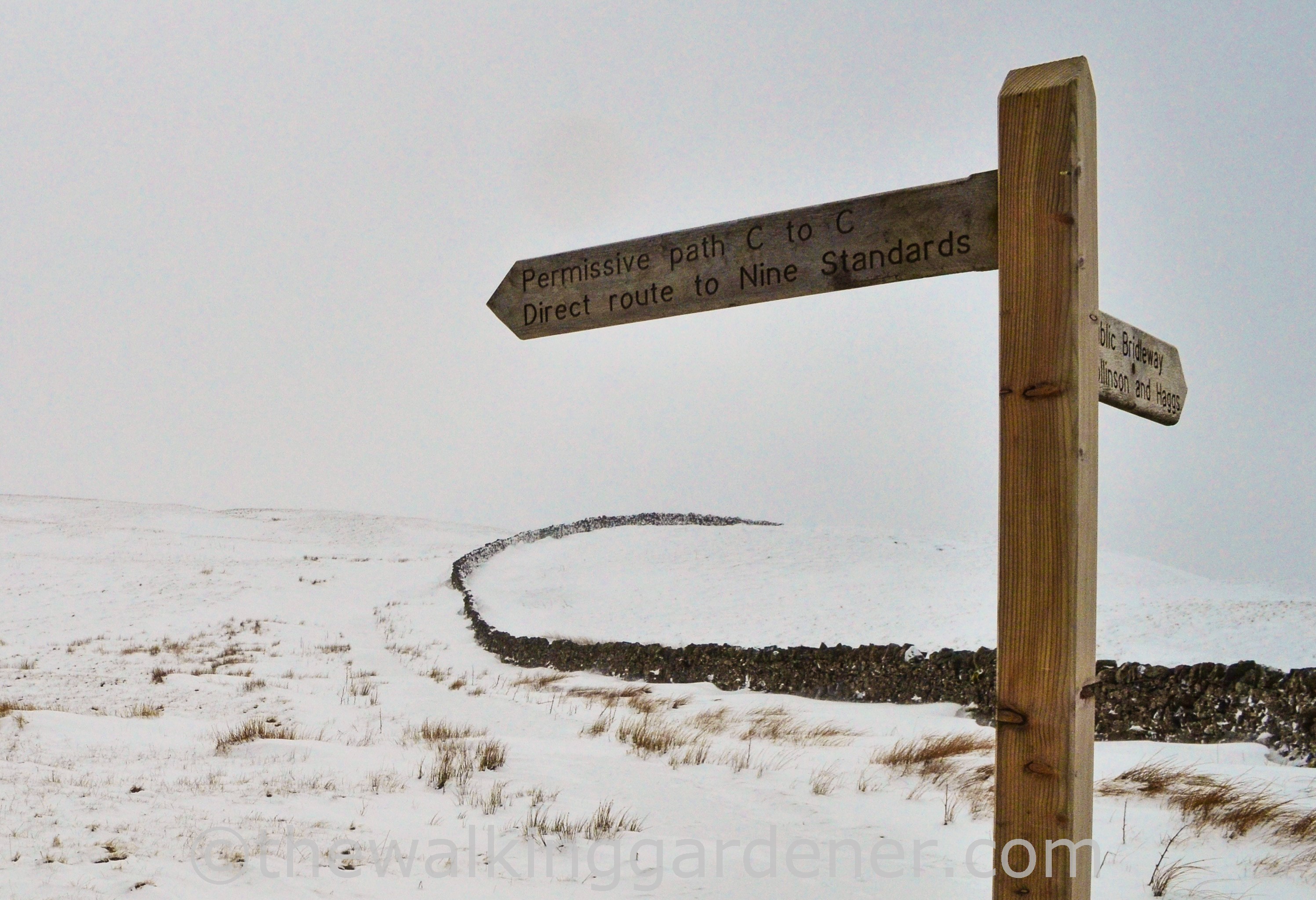
After an hour’s climb, we were back on snow. Near where this photo was taken, the Green Route goes off to the right avoiding the Nine Standards and heading for an early rendezvous with the Keld road. We went straight on.
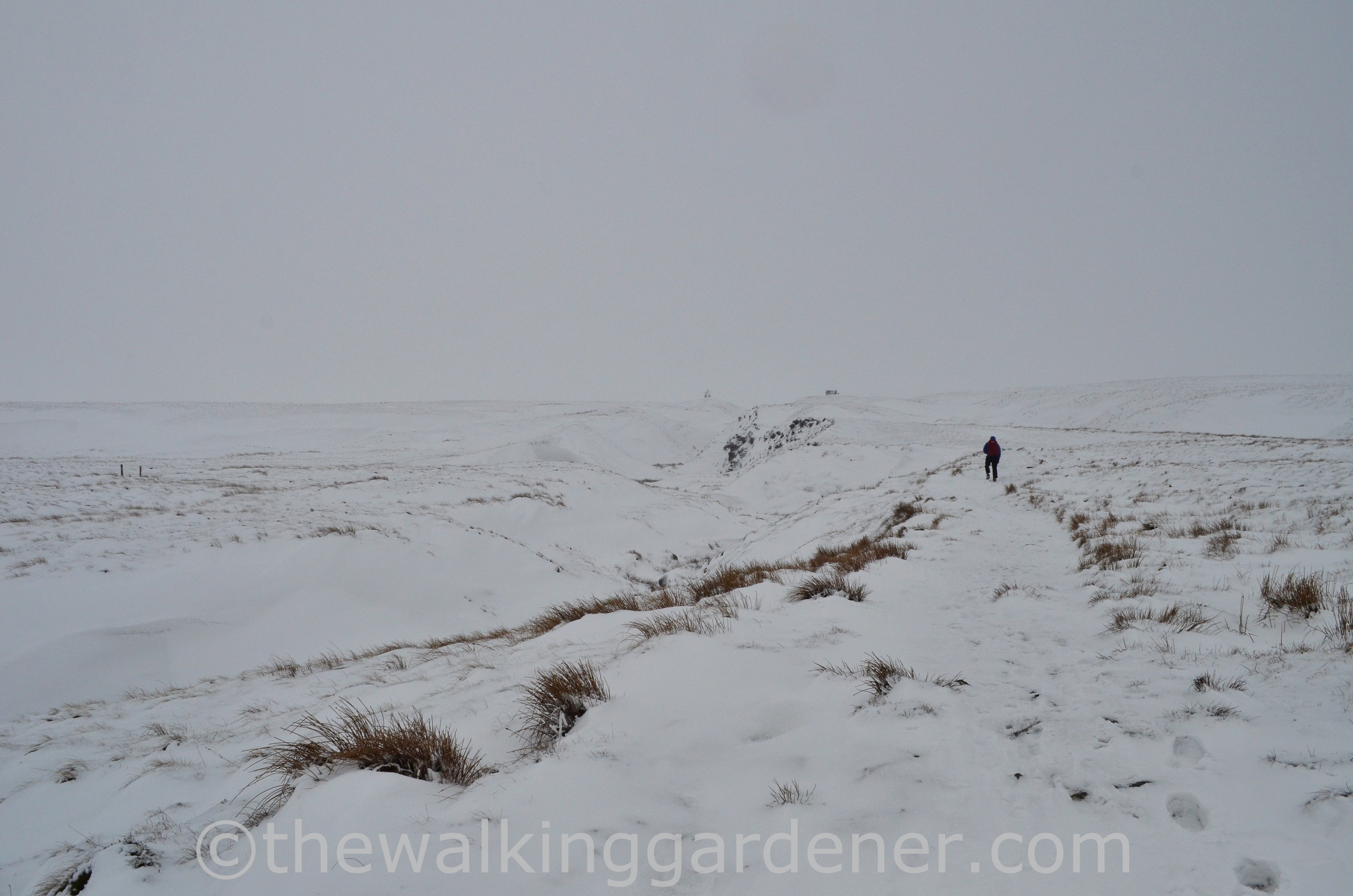
After Kirkby Stephen, we met no-one on today’s walk. Pat was the only person I saw crawling through that tundra landscape (there he is)
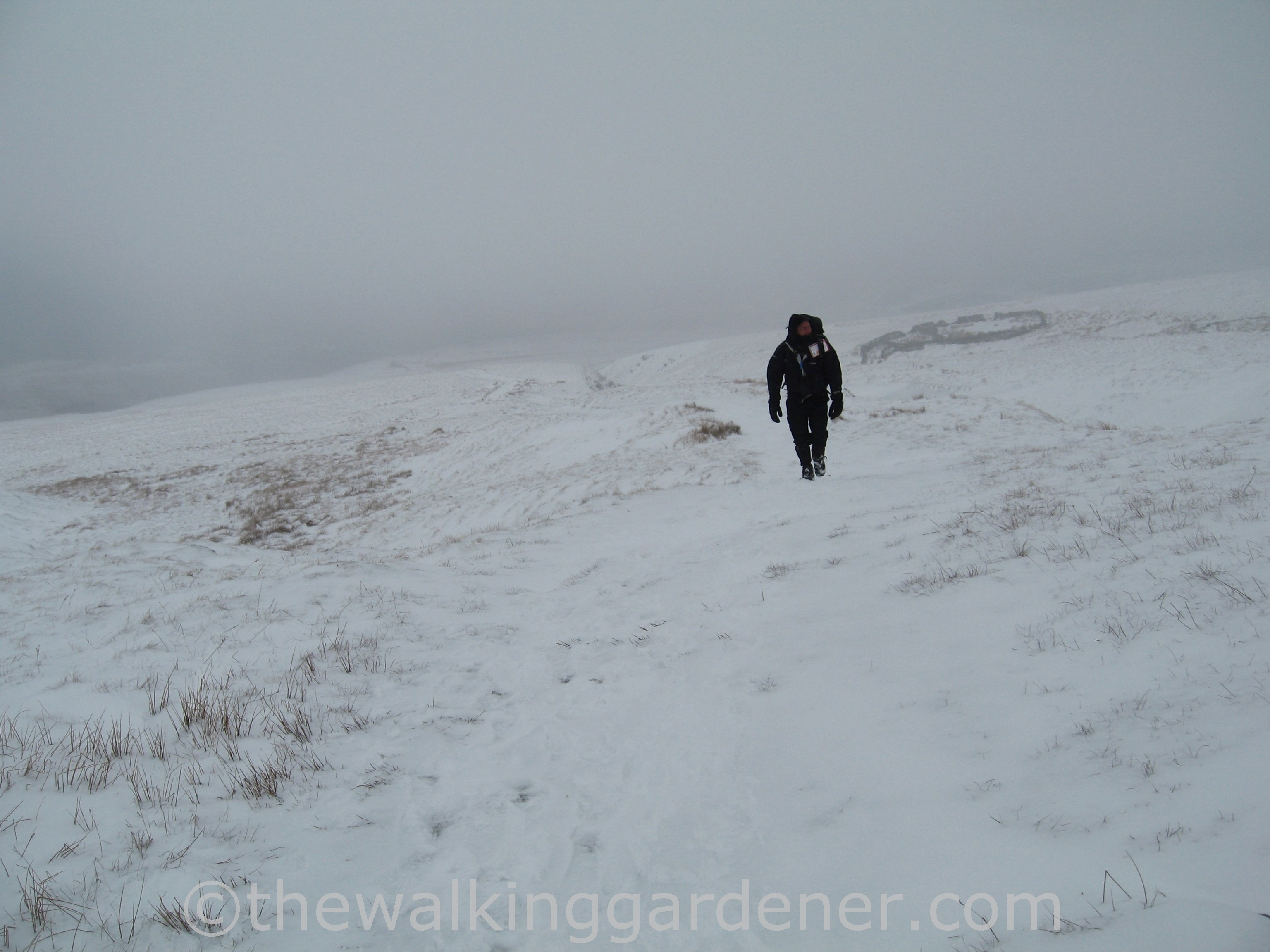
with me puffing and a huffing behind.
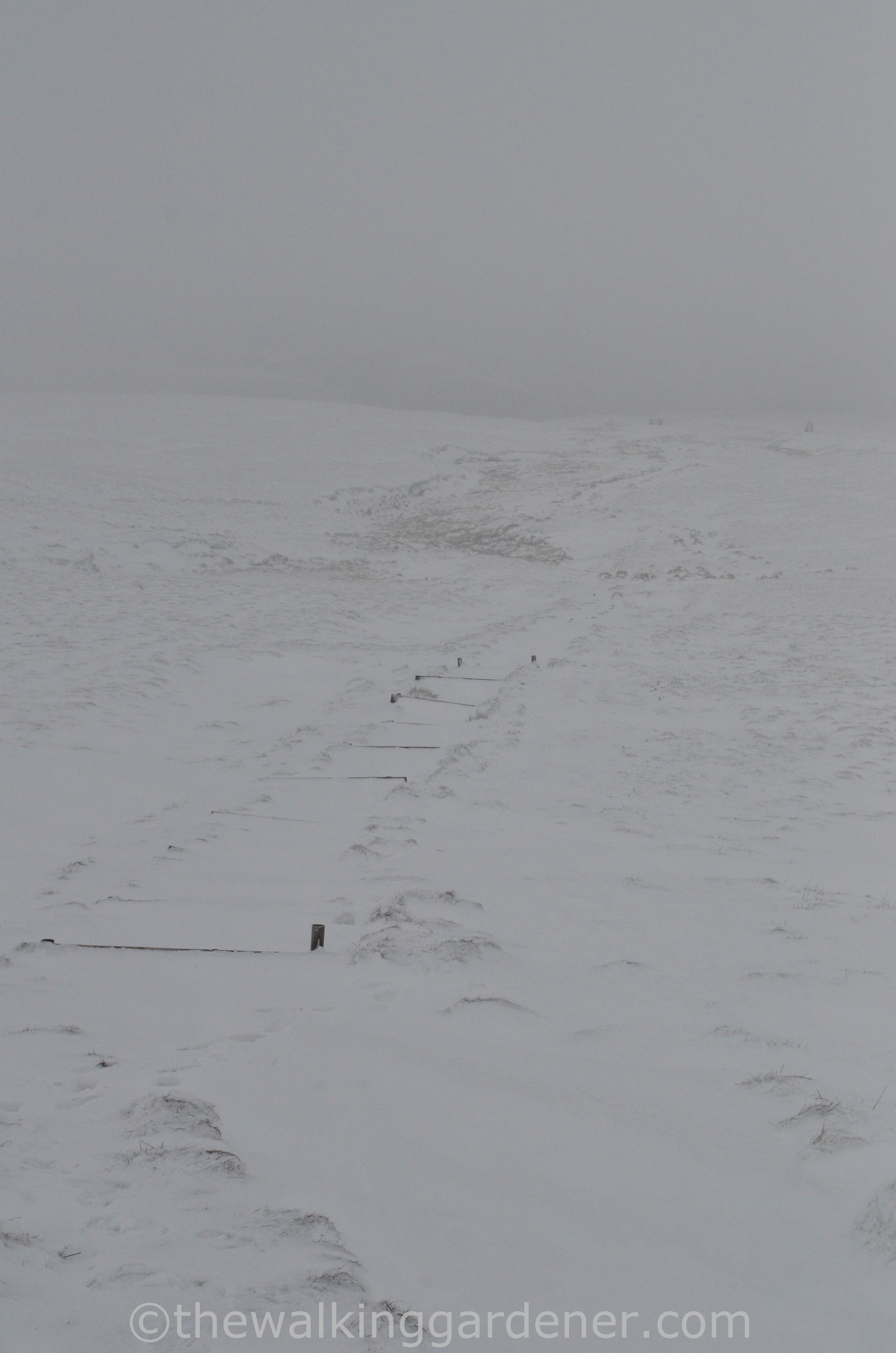
At this early stage, way-finding wasn’t too difficult. The path was visible but we couldn’t see very far ahead and we worried whether this was the correct path to the cairns.
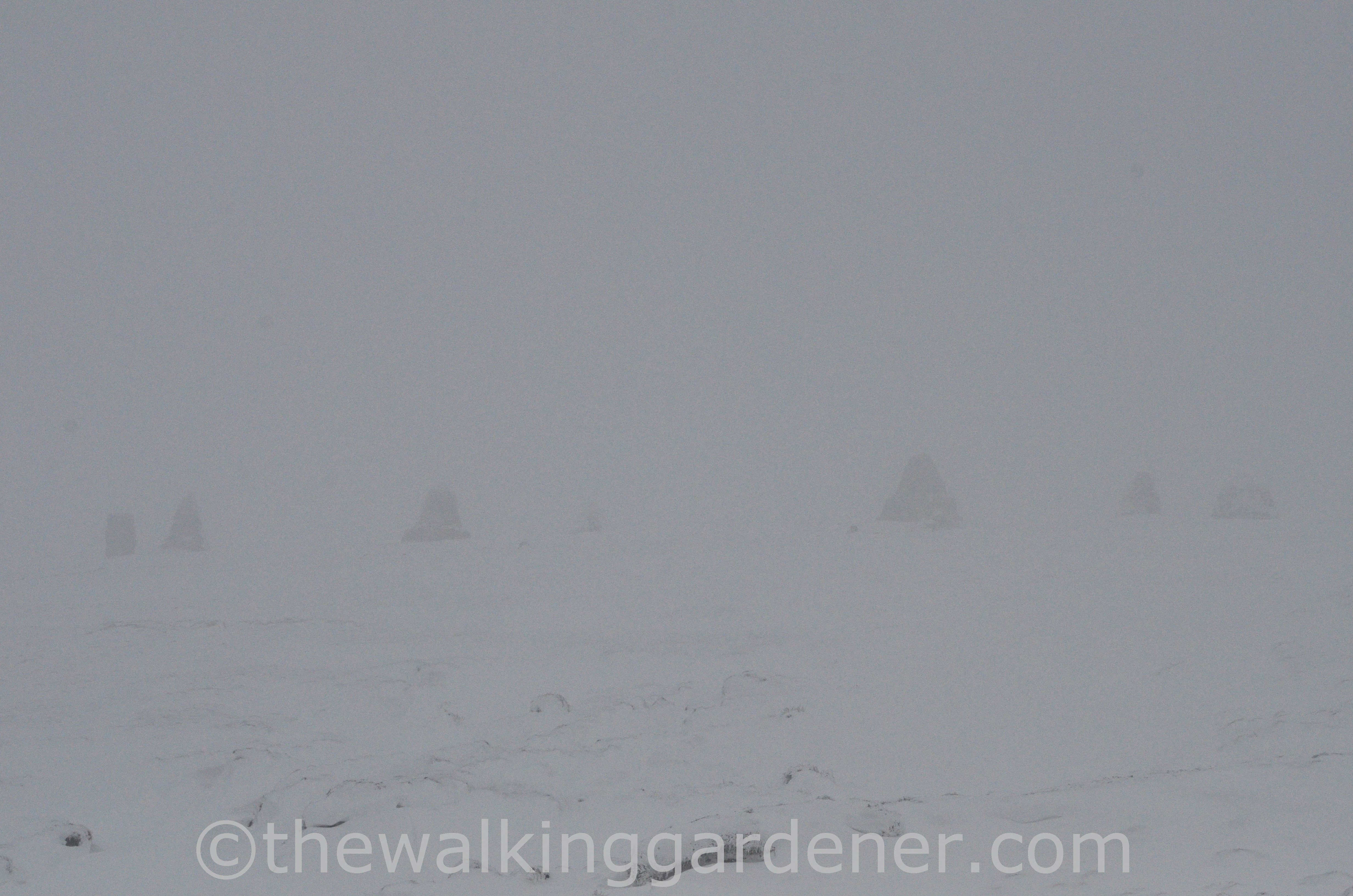
But then, suddenly, there they were – ghostly and indistinct, looming out of the mist. If you Google images of Nine Standards Rigg you’ll be presented with photos of them in clear, bright sunlight: a memory of them I certainly don’t share.
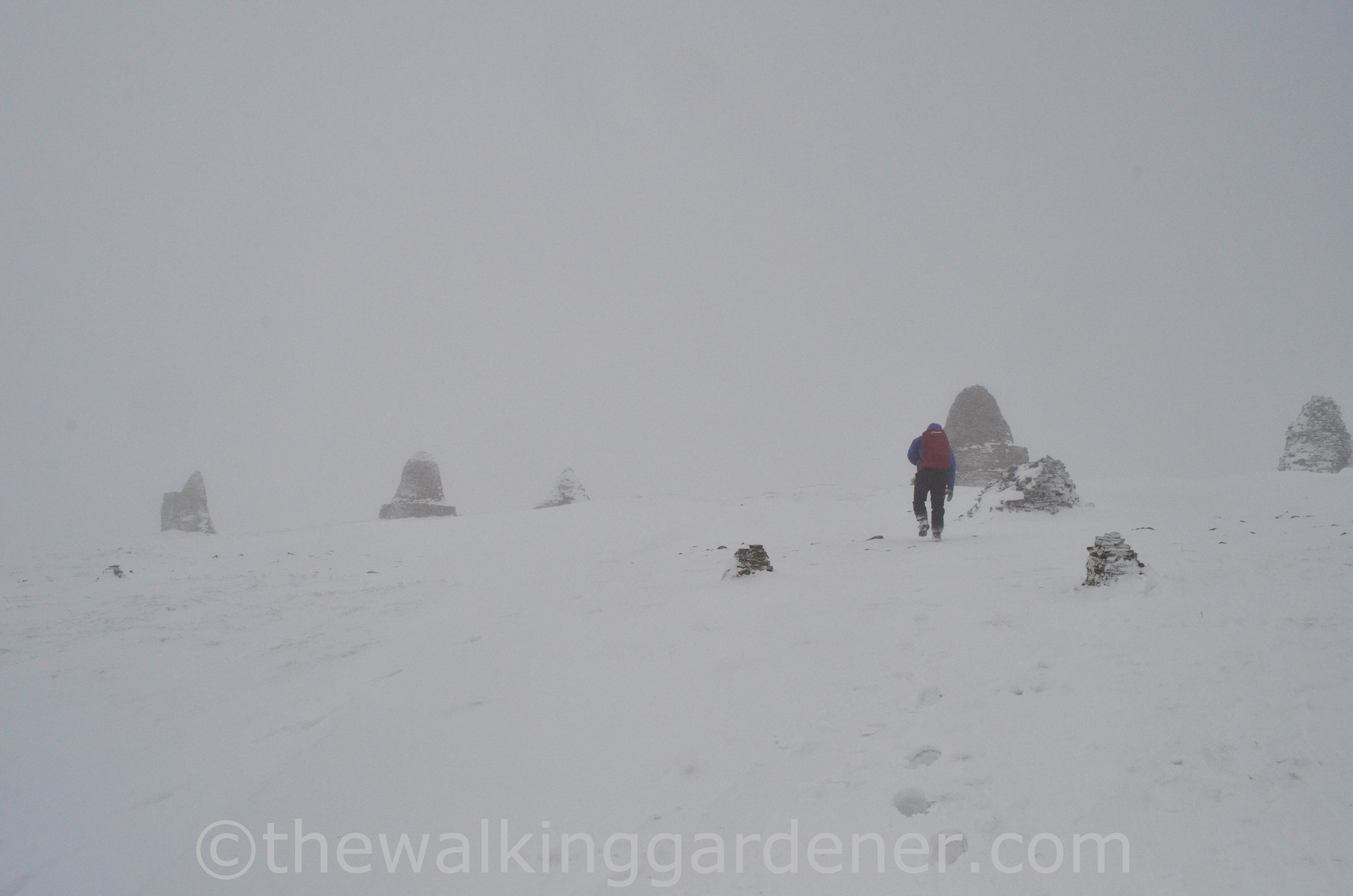
The wind up here was ferocious and the worst we faced before reaching the North York Moors. There is no higher ground on the C2C between here and the east coast;
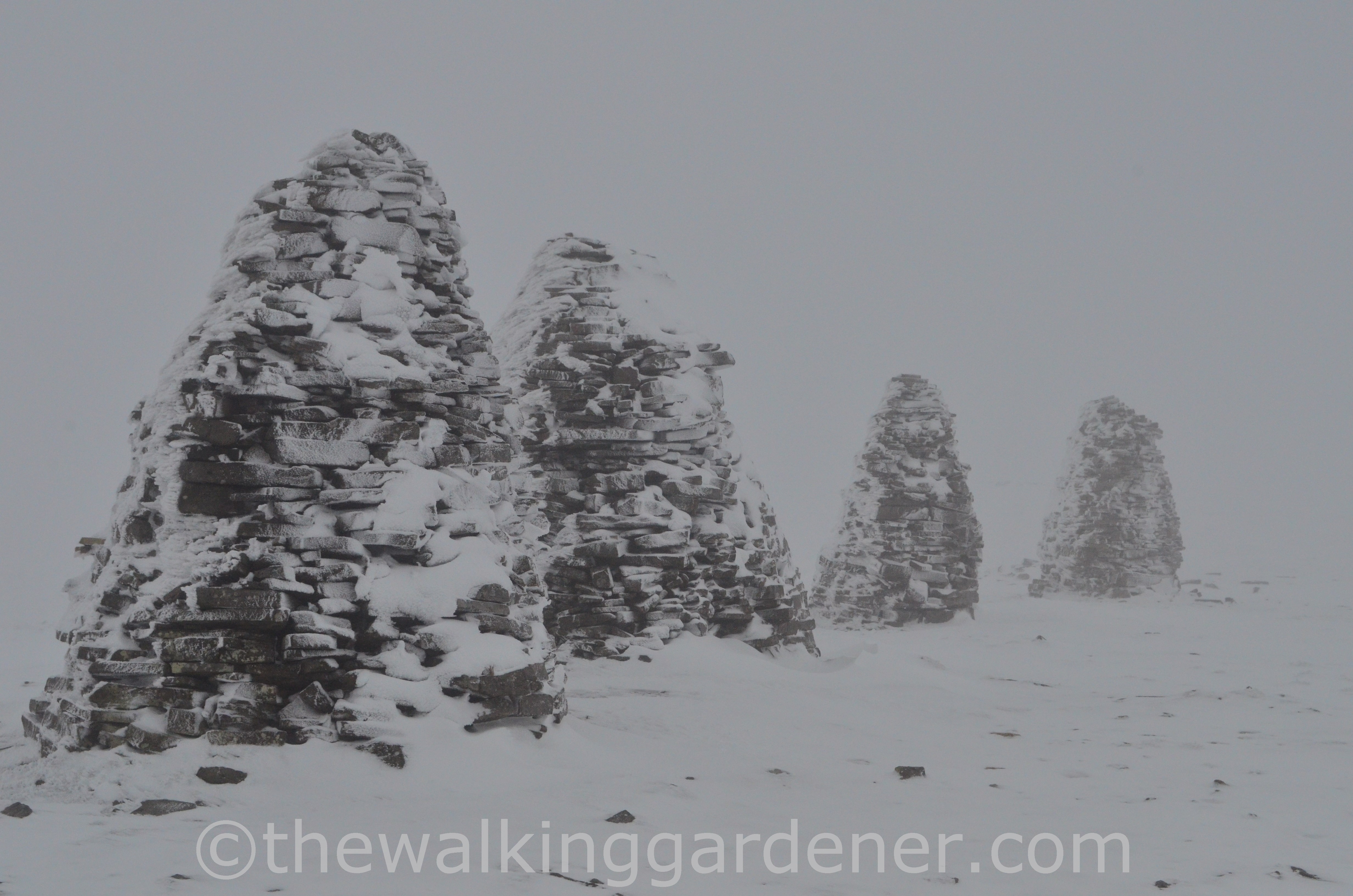
nothing to deflect the gusts whipping snow and ice up into our ruddy, chapped faces.
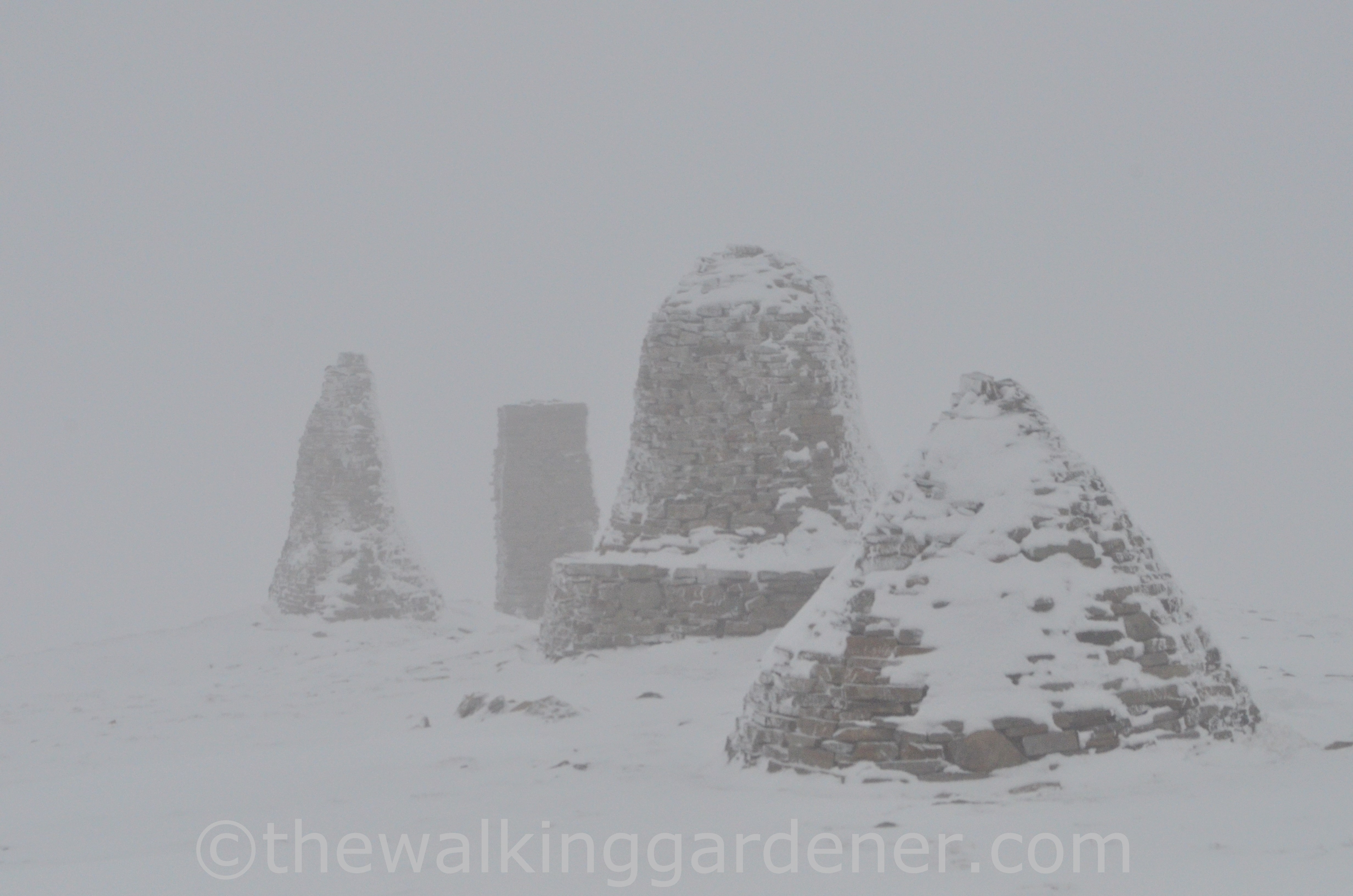
No one knows how old the cairns are or why they were built. They appear on C18th maps but some of them are much older, possibly prehistoric, and there are various theories as to their purpose. My favourite one is that, from a distance, they resemble an encamped English army and so acted as a deterrent to any marauding Scots in the valleys below. It is a nice idea but these piles of rocks were almost certainly boundary markers: the old county line between Westmorland and Yorkshire cuts through here.
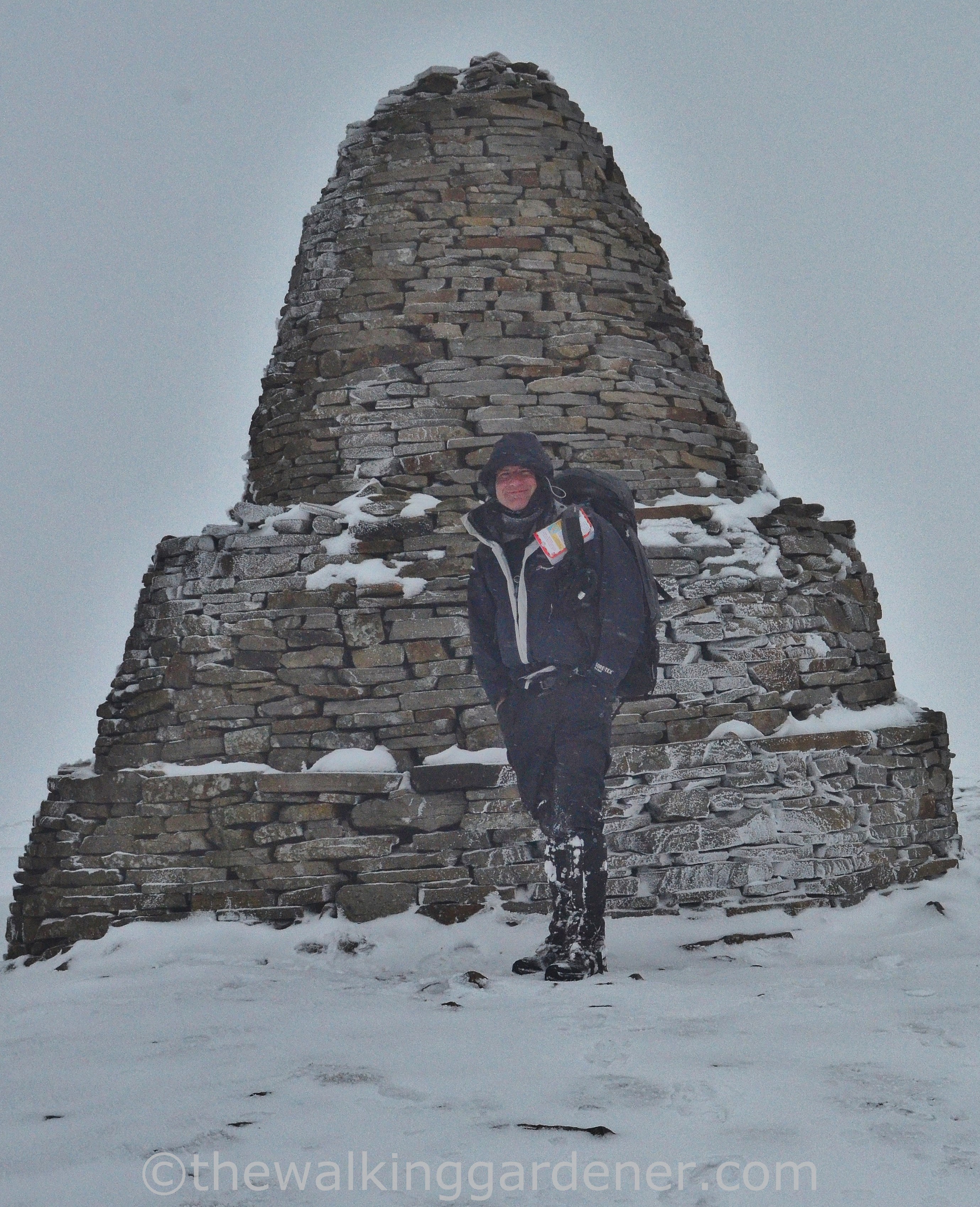
Whatever their original purpose, they gave us some shelter from the howling, icy blast. As we took photos, barely able to make ourselves heard above the roar of the wind (in a landscape so ridiculously inhospitable it made me giggle) Pat and I were at a watershed of the Pennines: behind us all the trickles, streams and rivers flow into the Irish Sea; in front they all empty into the North Sea.
With no views, freezing cold and a long, uncertain walk ahead of us, we smiled ruefully at our plan to use the Rigg as a lunch-stop and hurriedly fled.
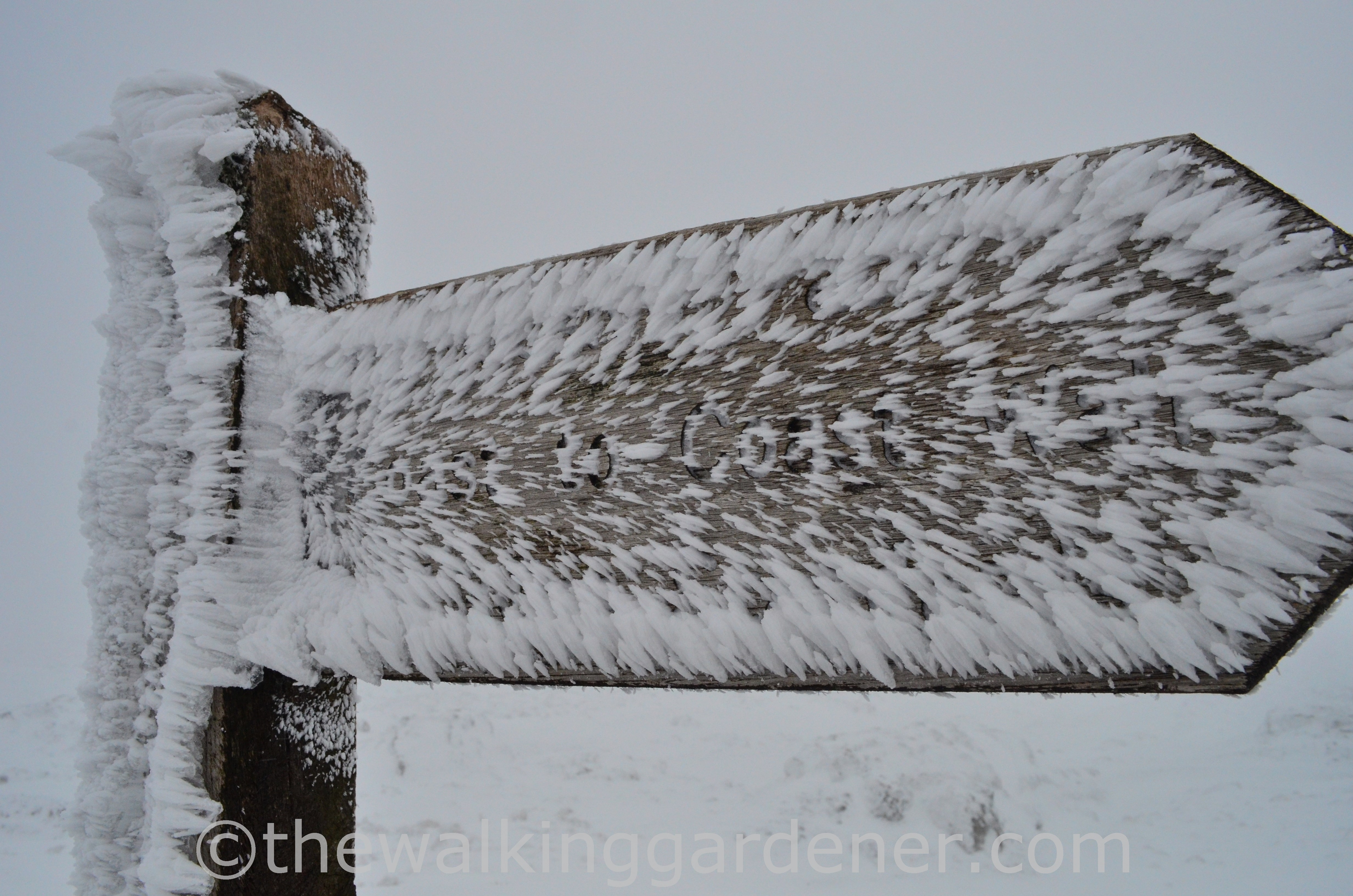
Visibility was poor (even when we could bear to look up into stinging, icy flecks) but we found the above sign and behind it a line of half-buried posts marking the Blue Route leading off to the east. The Green Route heads south for the Keld road here but, given we had come so far, we decided to press on and followed the Blue straight ahead towards Whitsundale.
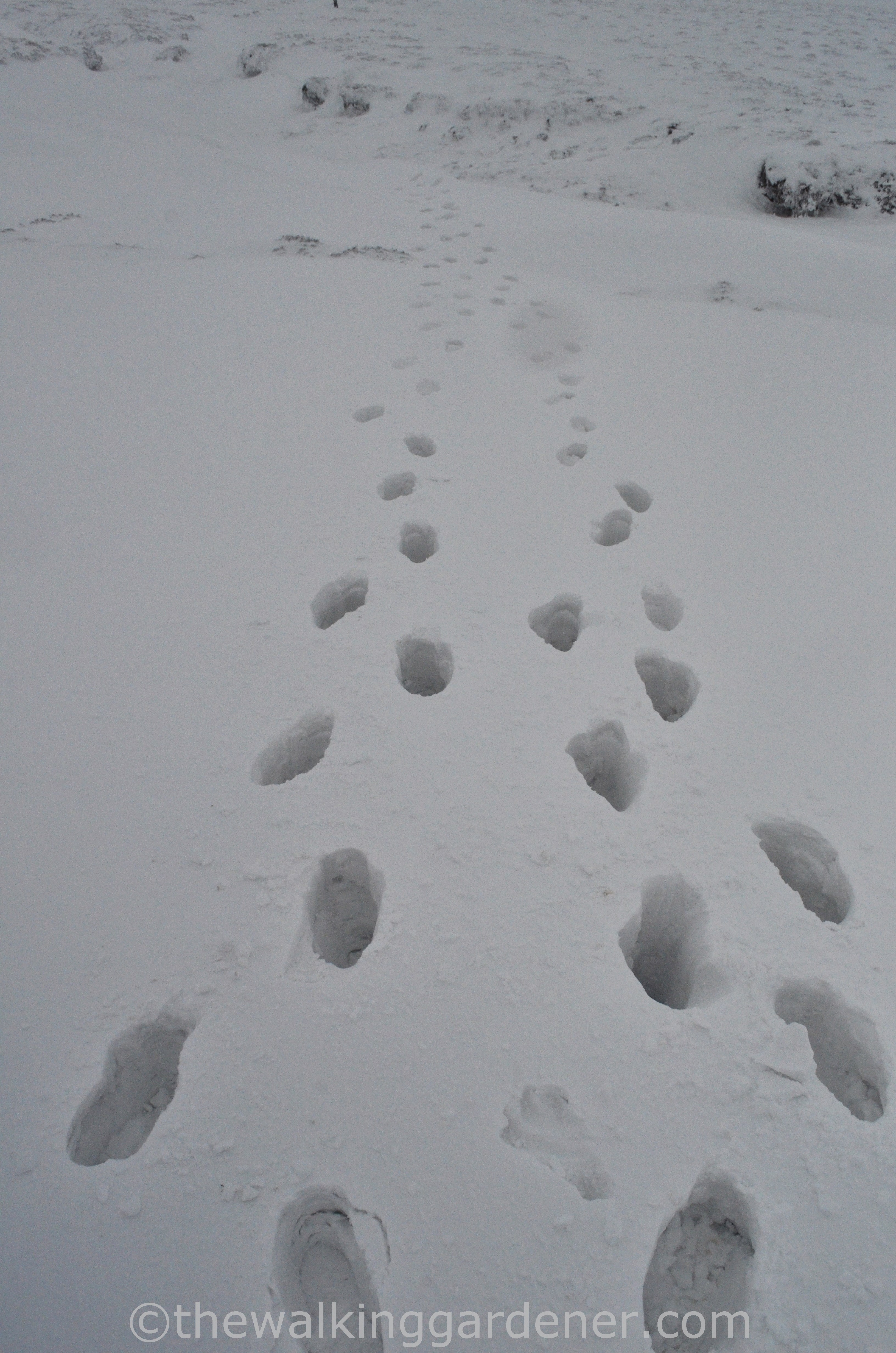
The summit had been wind-scoured rock but soon we were wading across deep snow,
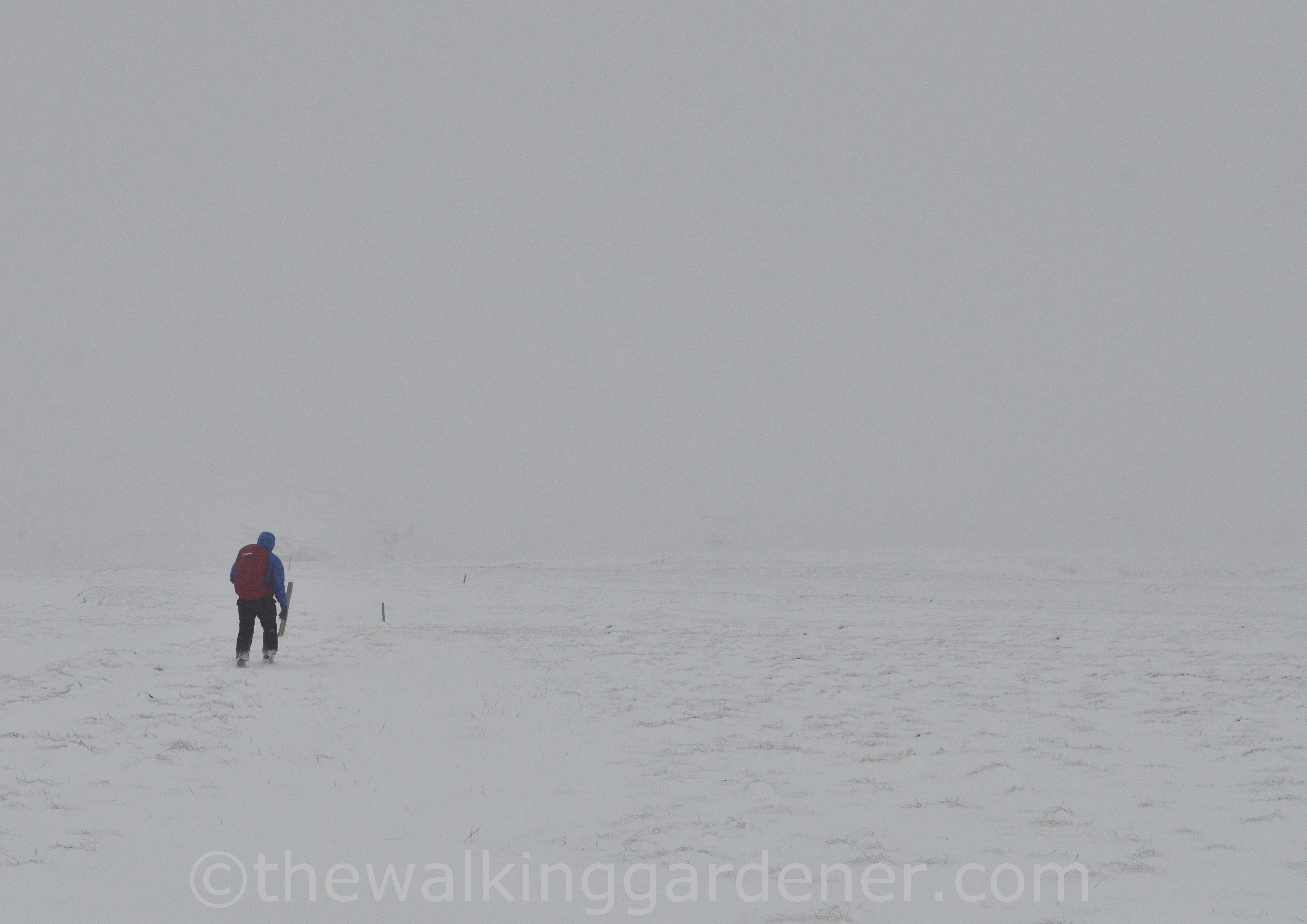
peering ahead, checking my compass and trying to make out the posts lining the path.
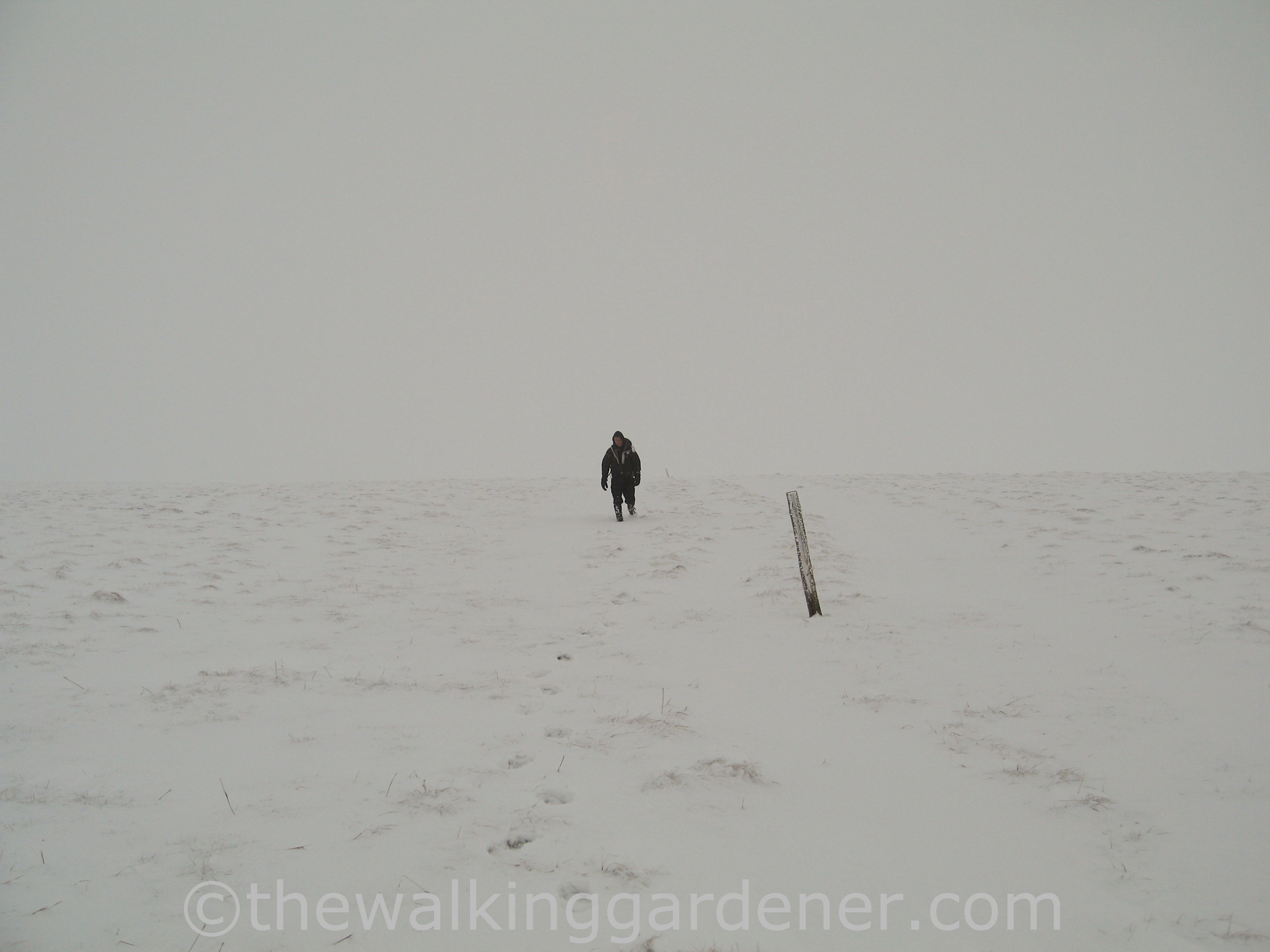
But actually, the snow proved helpful; often it was deep enough to keep us several inches above sopping peat bog. Had it not, we would have diverted to the road.
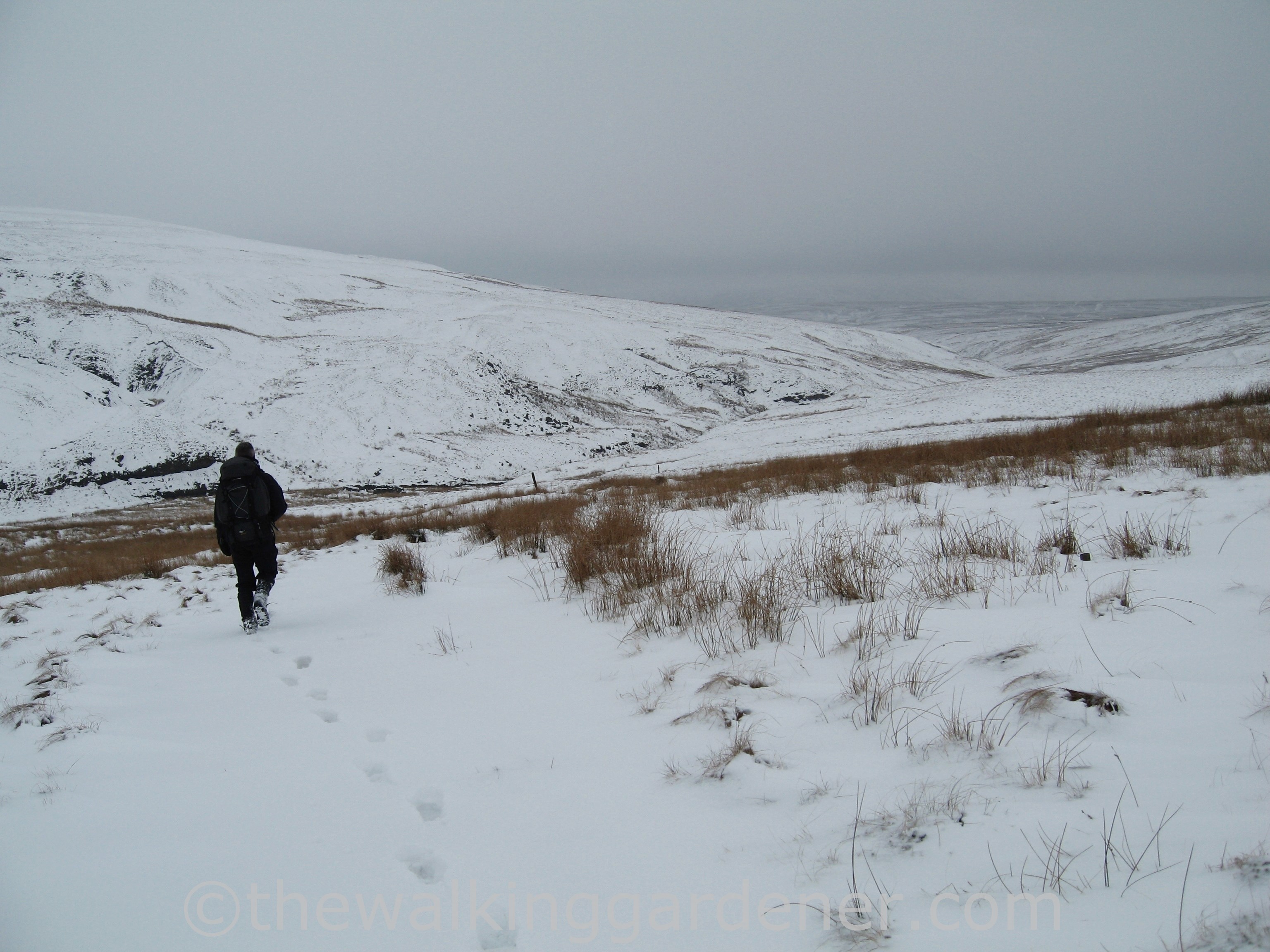
After an hour or two, we dipped below the cloud, the snow thinned and Whitsundale and the way to Keld lay below us.
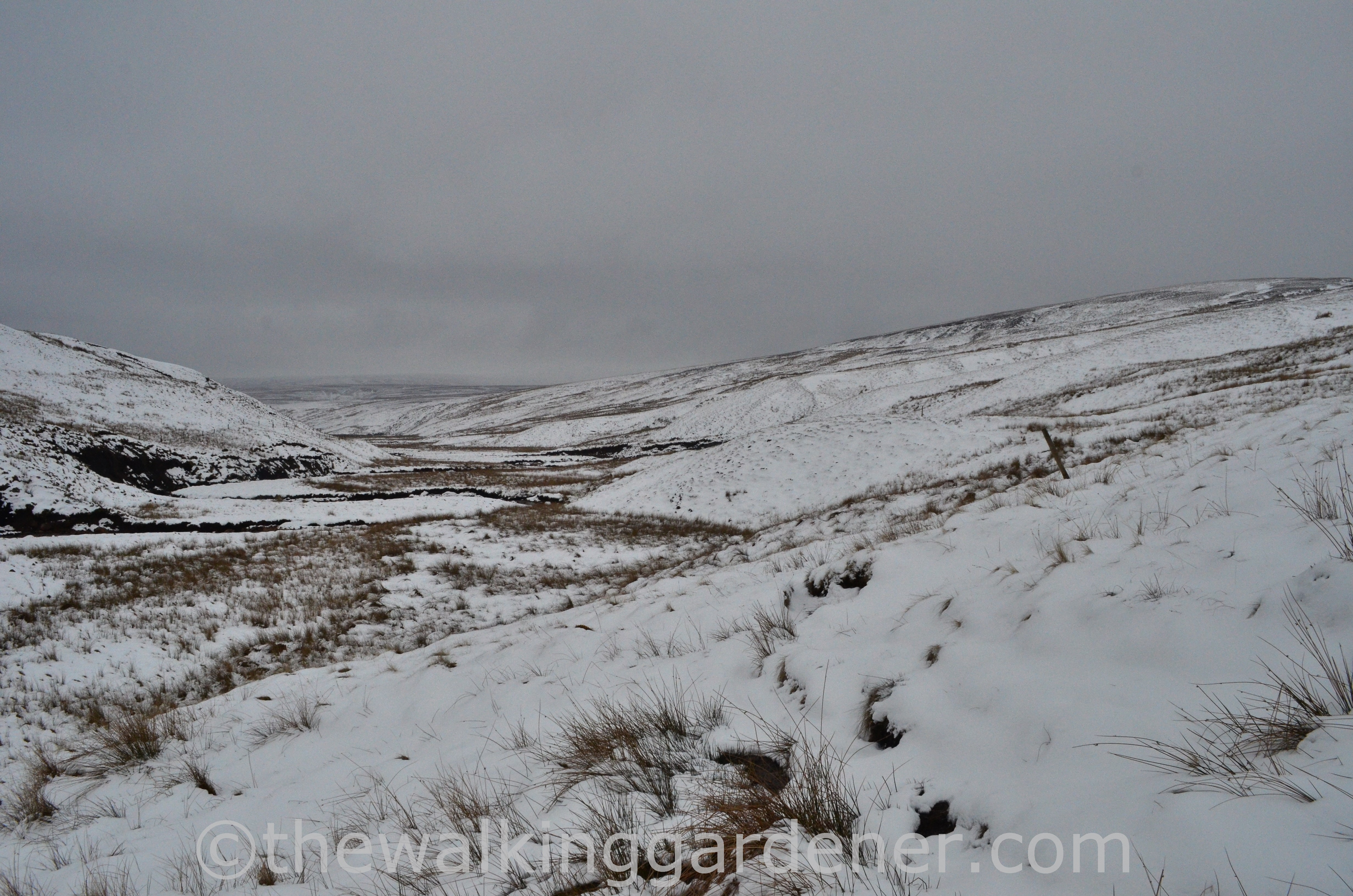
I had assumed that our pace would quicken now, following the beck as it meandered across the flat valley bottom. But the path was mostly invisible as we slid and stumbled over tussocky grass, moss, sedge and rocks; skirting pools and mires and streams.
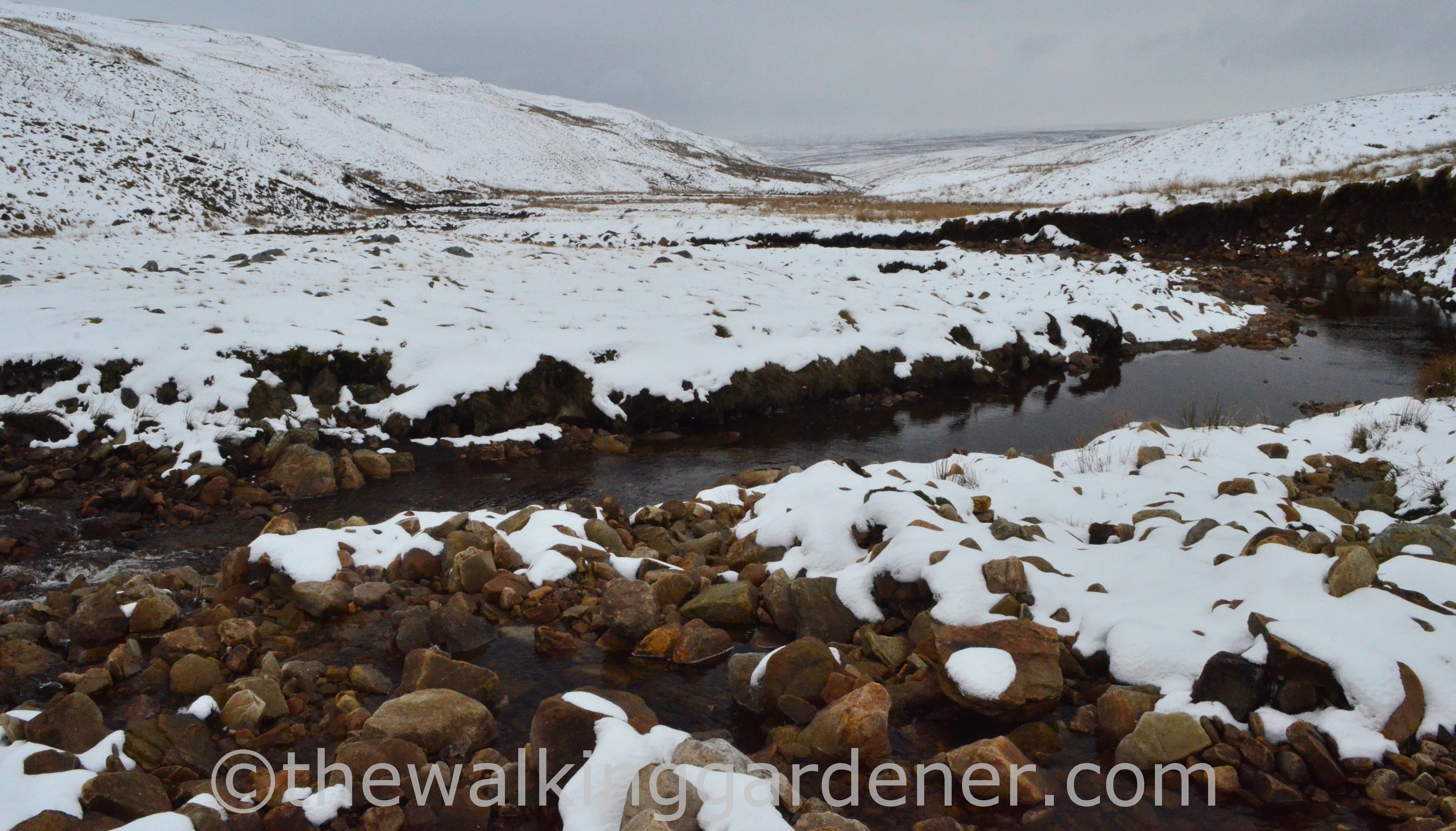
With no deep snow to lift us above bog and stones, this was slow, finicky going.
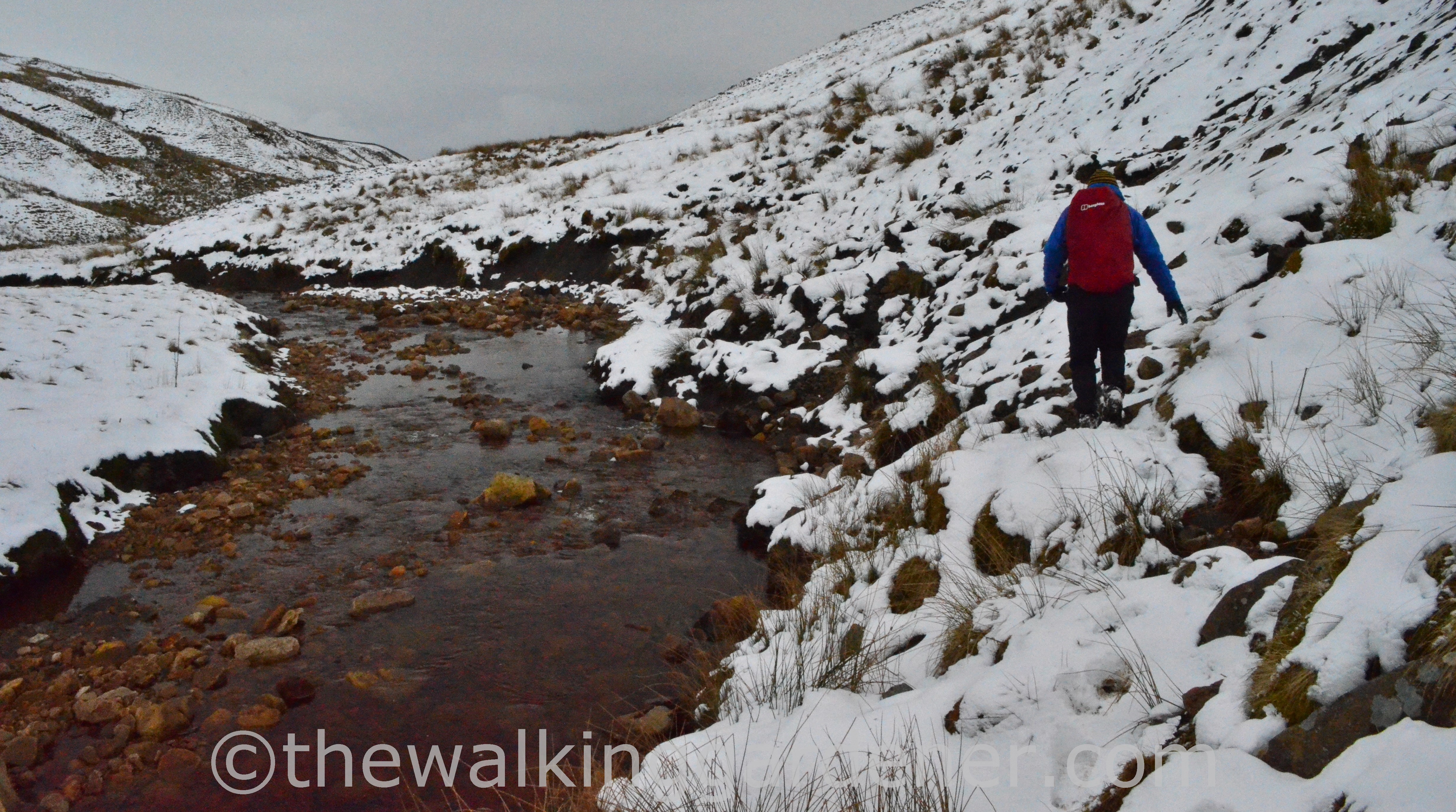
Whitsundale Beck seemed cruelly long, with every bend in the valley proving false hope that we had reached its end.
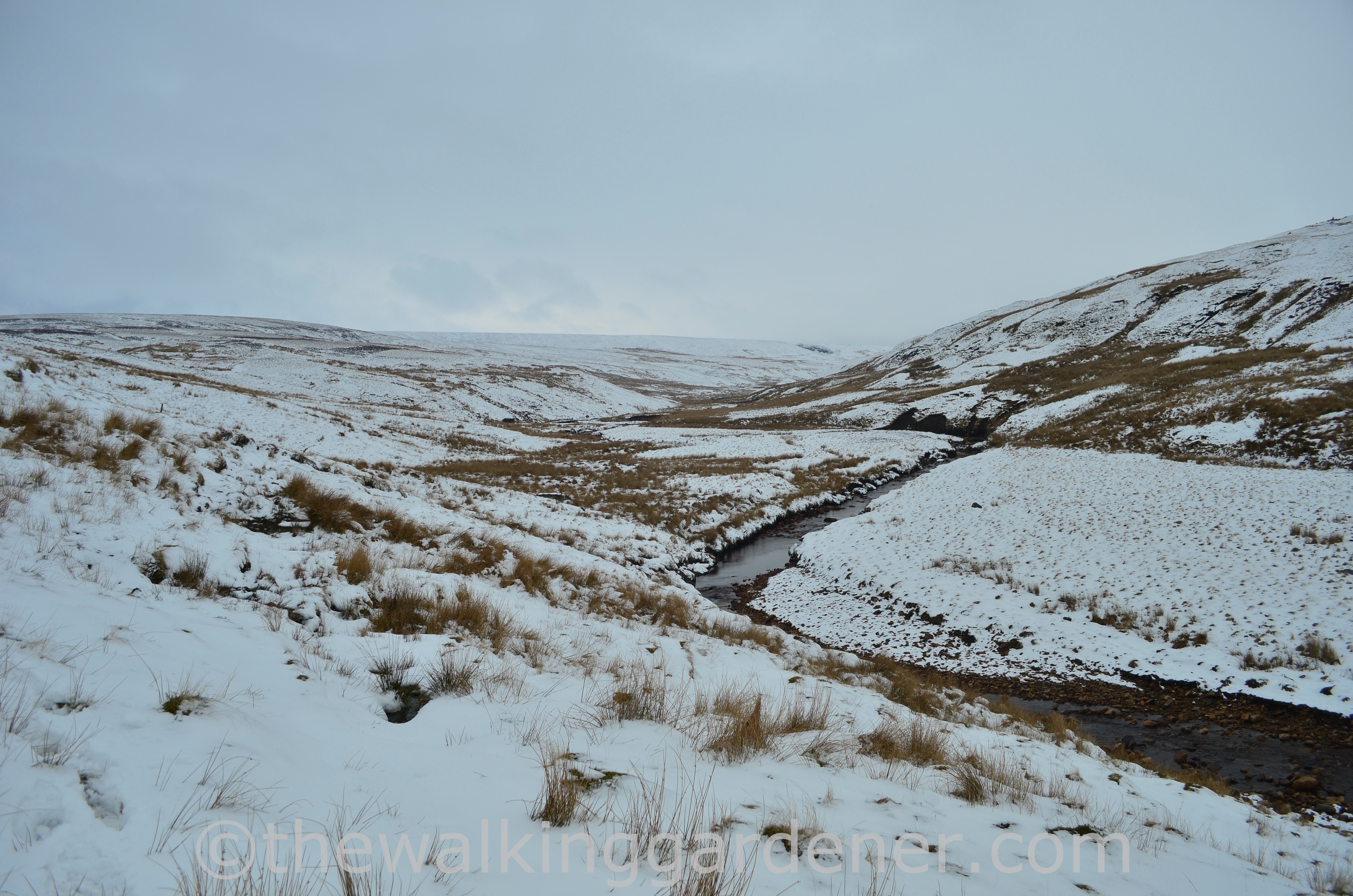
Though it may not look particularly difficult from these photos, this stretch of ‘path’ was one of the most arduous of the 12 days.
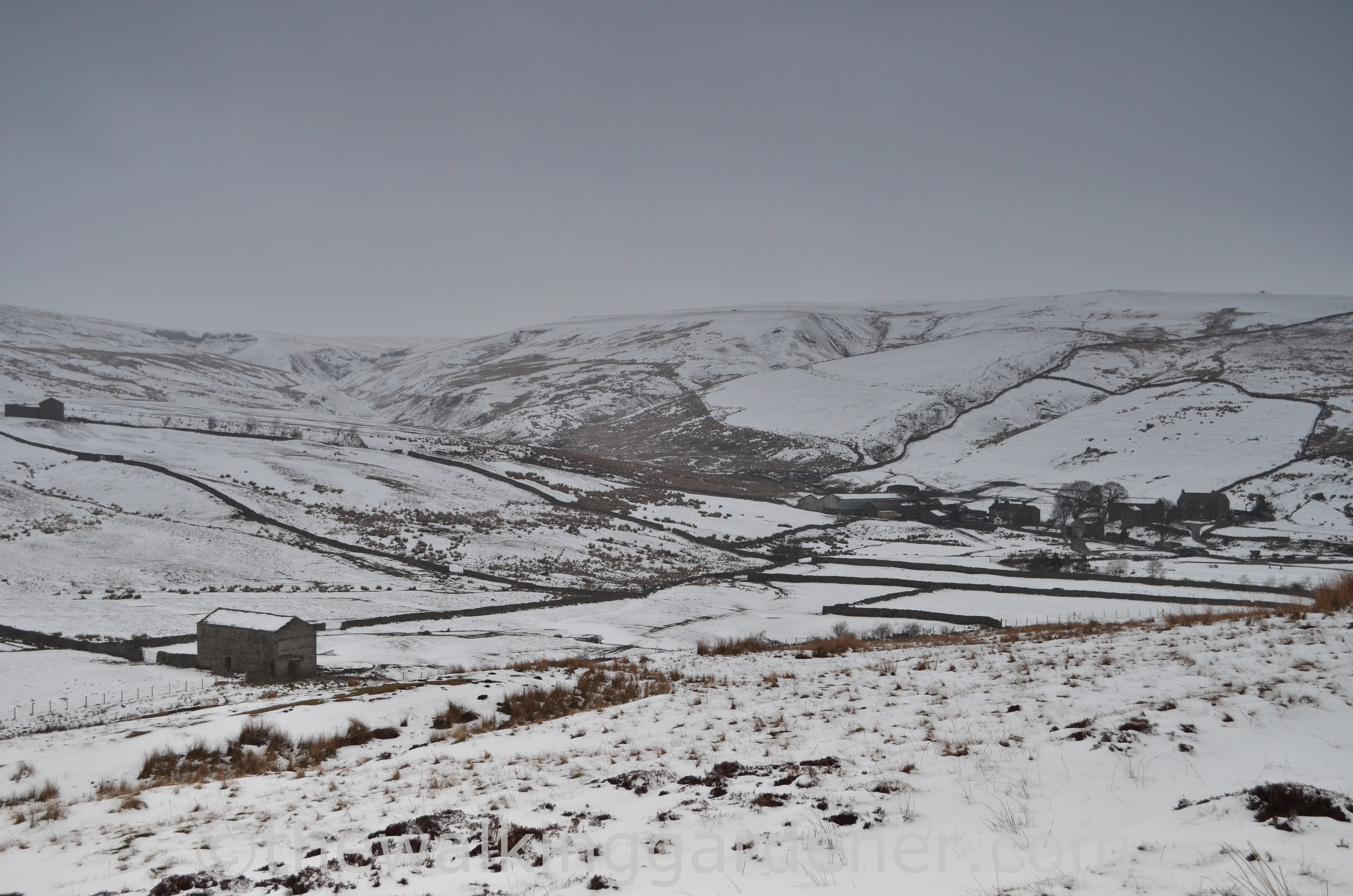
Finally, at about 2.30 we reached signs of habitation
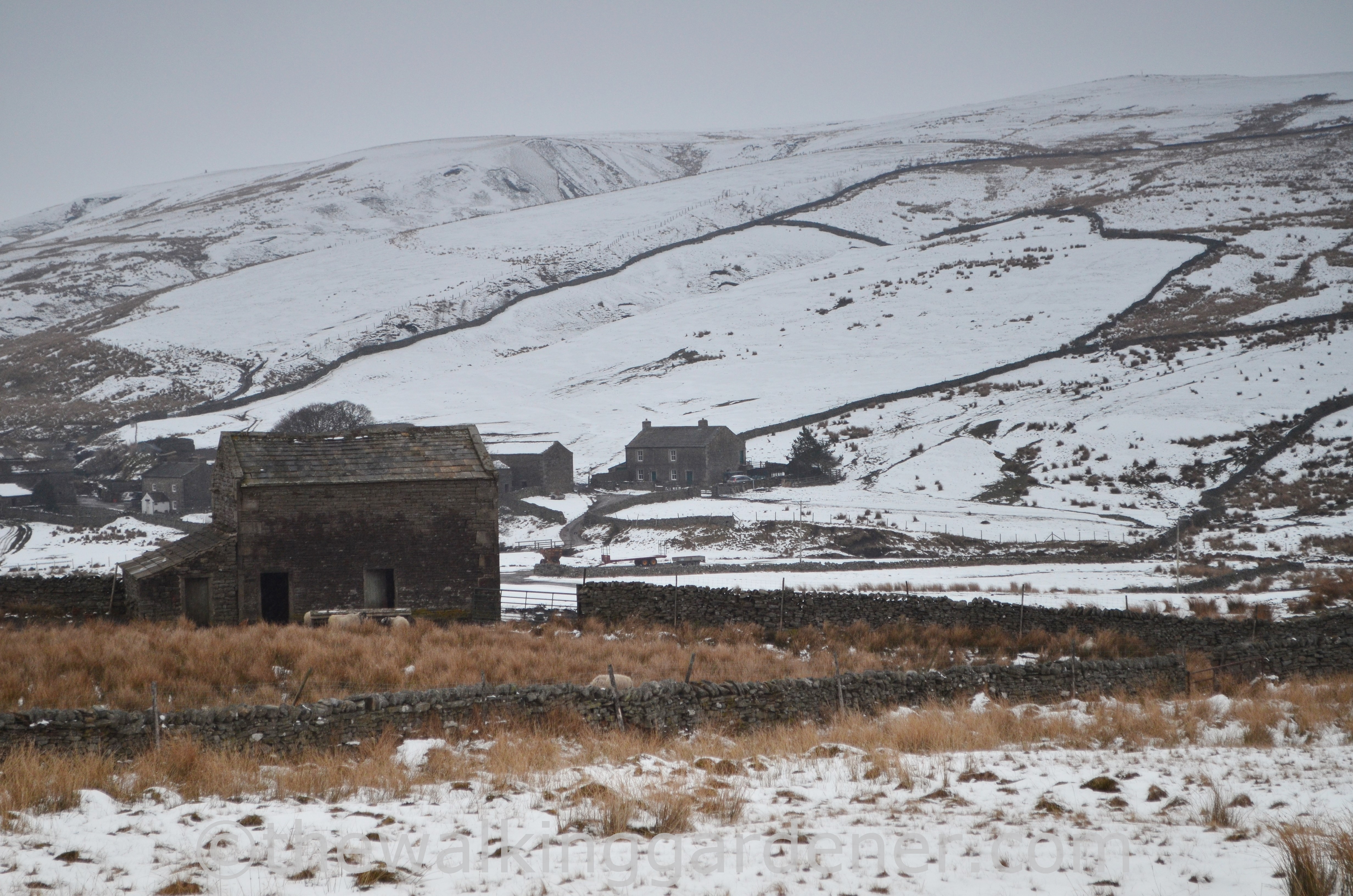
and ‘Ravenseat Farm tea garden.’ I had had my heart set on a mug of hot tea and a slab of cake as big as a family saloon car but it was closed. Most decidedly and cruelly closed. Fighting back whimpers, we scurried on.
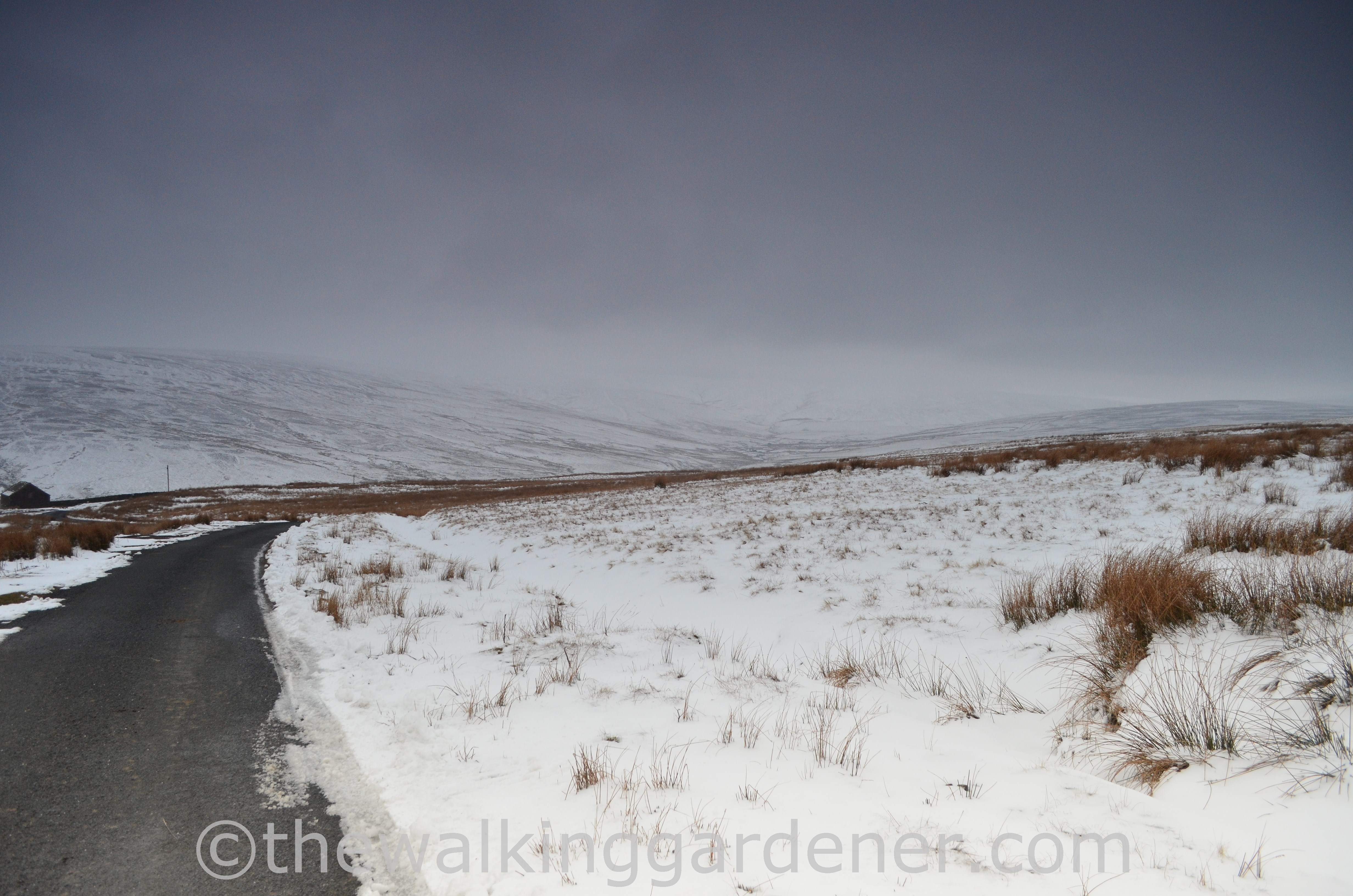
I cheerfully admit to ‘cheating’ at this point. Sneer and point as much as you like, I shall feel no shame. Shortly after Ravenseat, we abandoned the official route where it follows the beck on the far side of the valley. Fading now, and achy, after our efforts on the moors, we tramped along a tarmac lane to finally join the B6270 for the last couple of miles to my bed.
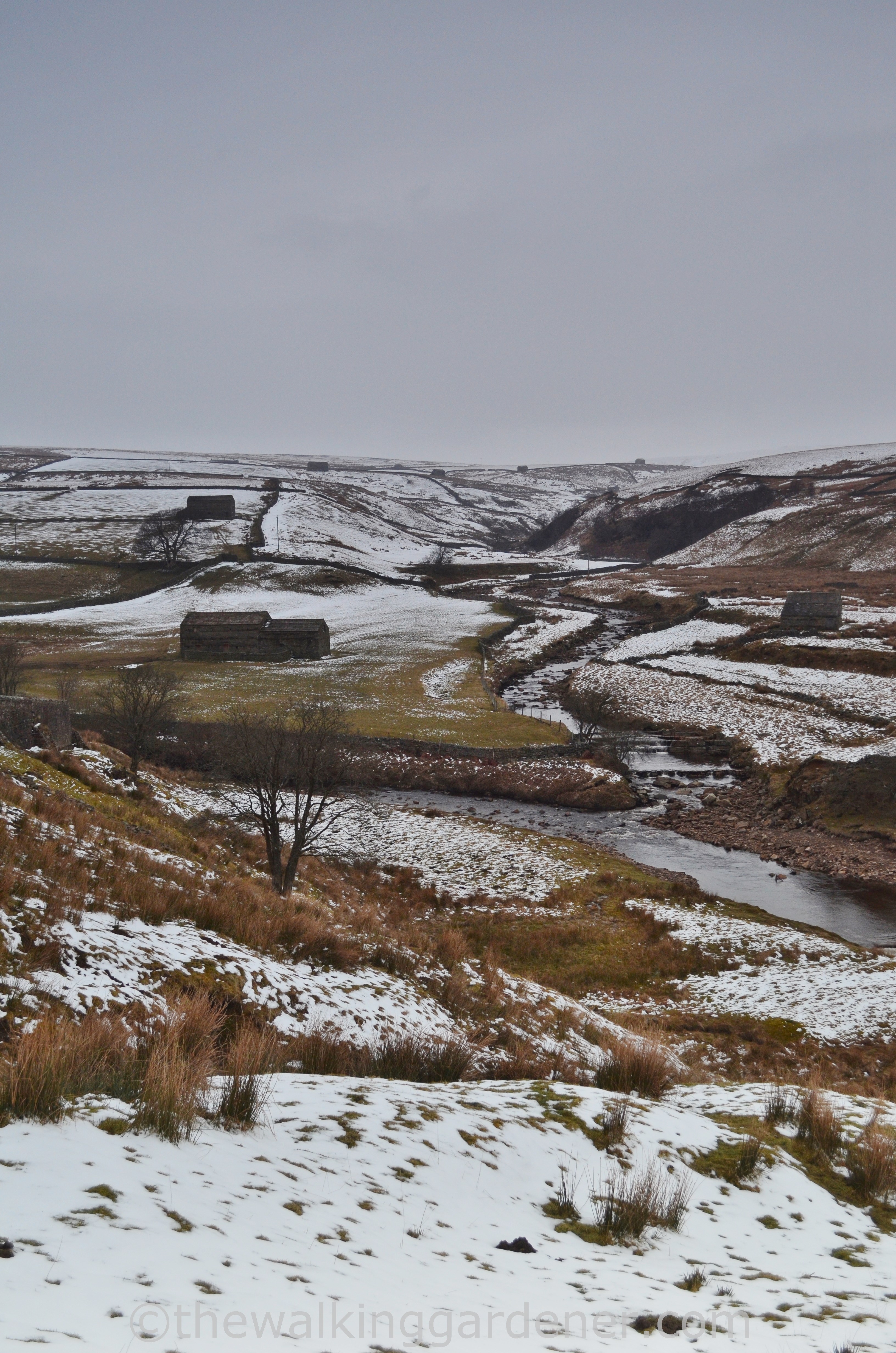
As Pat had further to go (he was meeting his wife Sue a couple of miles beyond Keld), I bid him farewell till the morning and watched him surge ahead with his namby-pamby day sack. Sorry, jealously is rarely attractive.
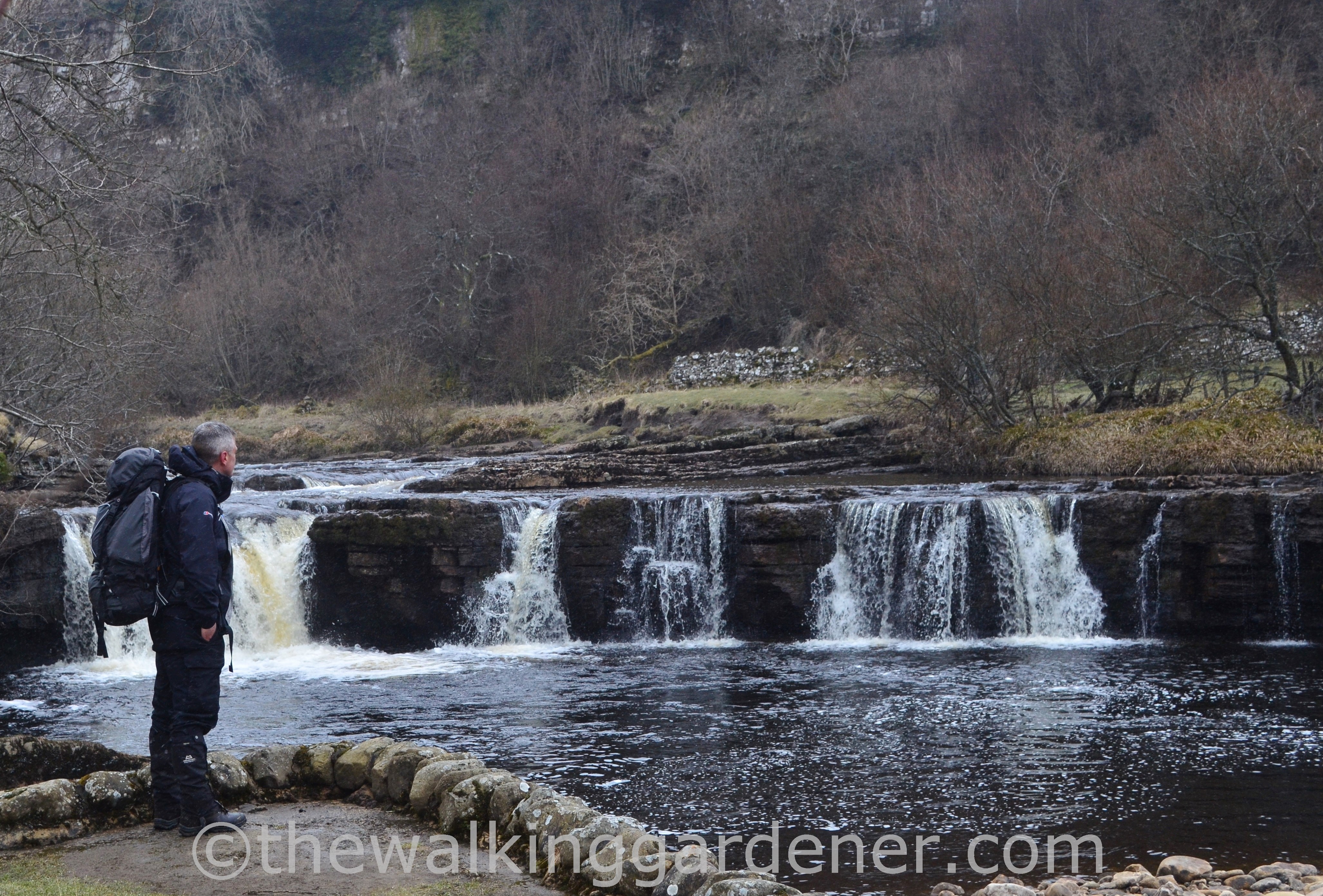
I dropped down a gear and then another, and paused to enjoy my first visit to Swaledale.
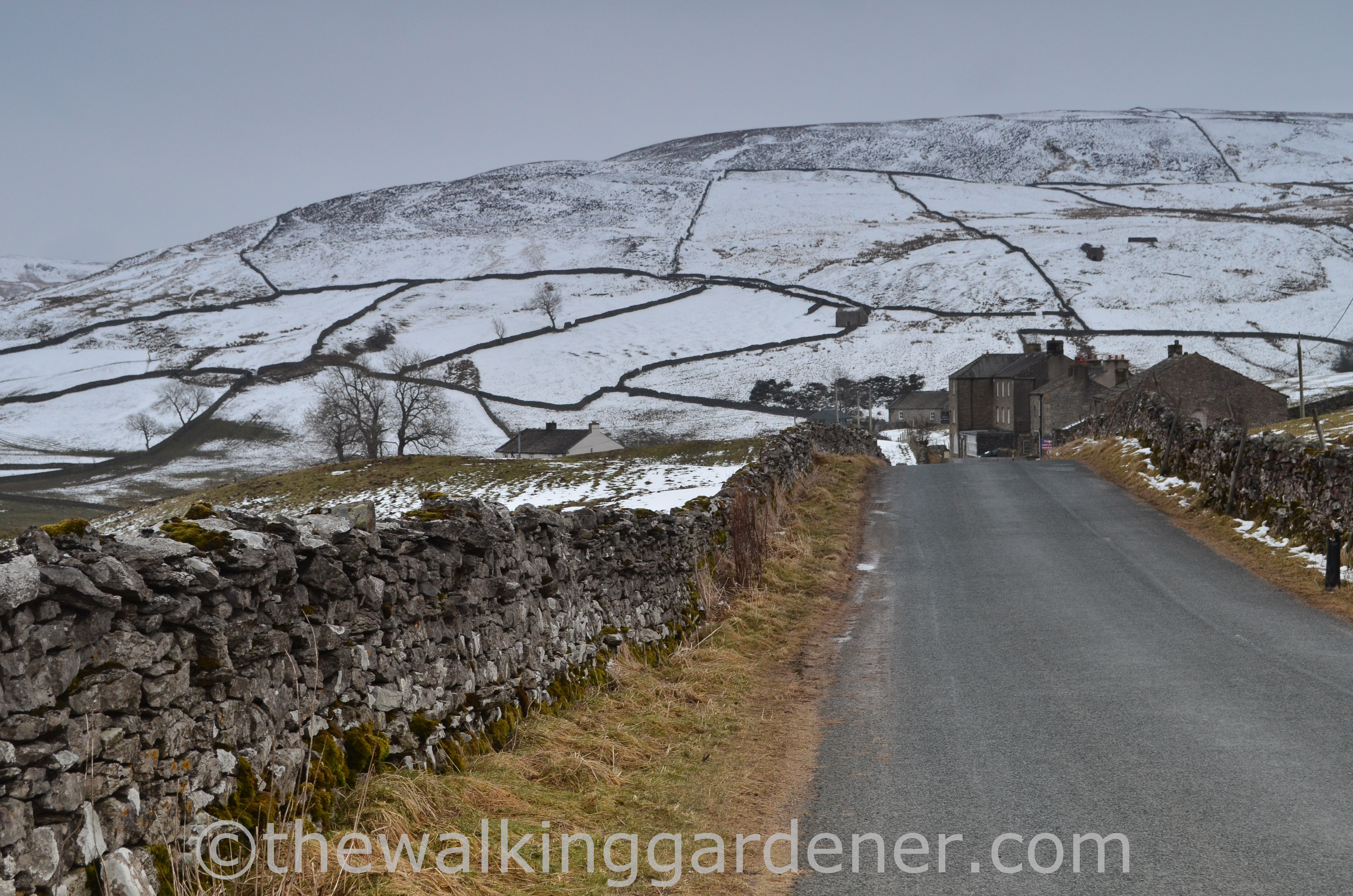
My home for the night was ‘The Keld Lodge‘ and Matt, the manager, gave me a very warm, very surprised welcome. Though I had pre-booked some weeks before, Matt was certain that I would be a no-show. That I would cancel. As I told him about the route we had taken and why, he was astonished that anyone would have advised us to cross the moors in snow and strong winds – on either the Green, Blue or Red route.
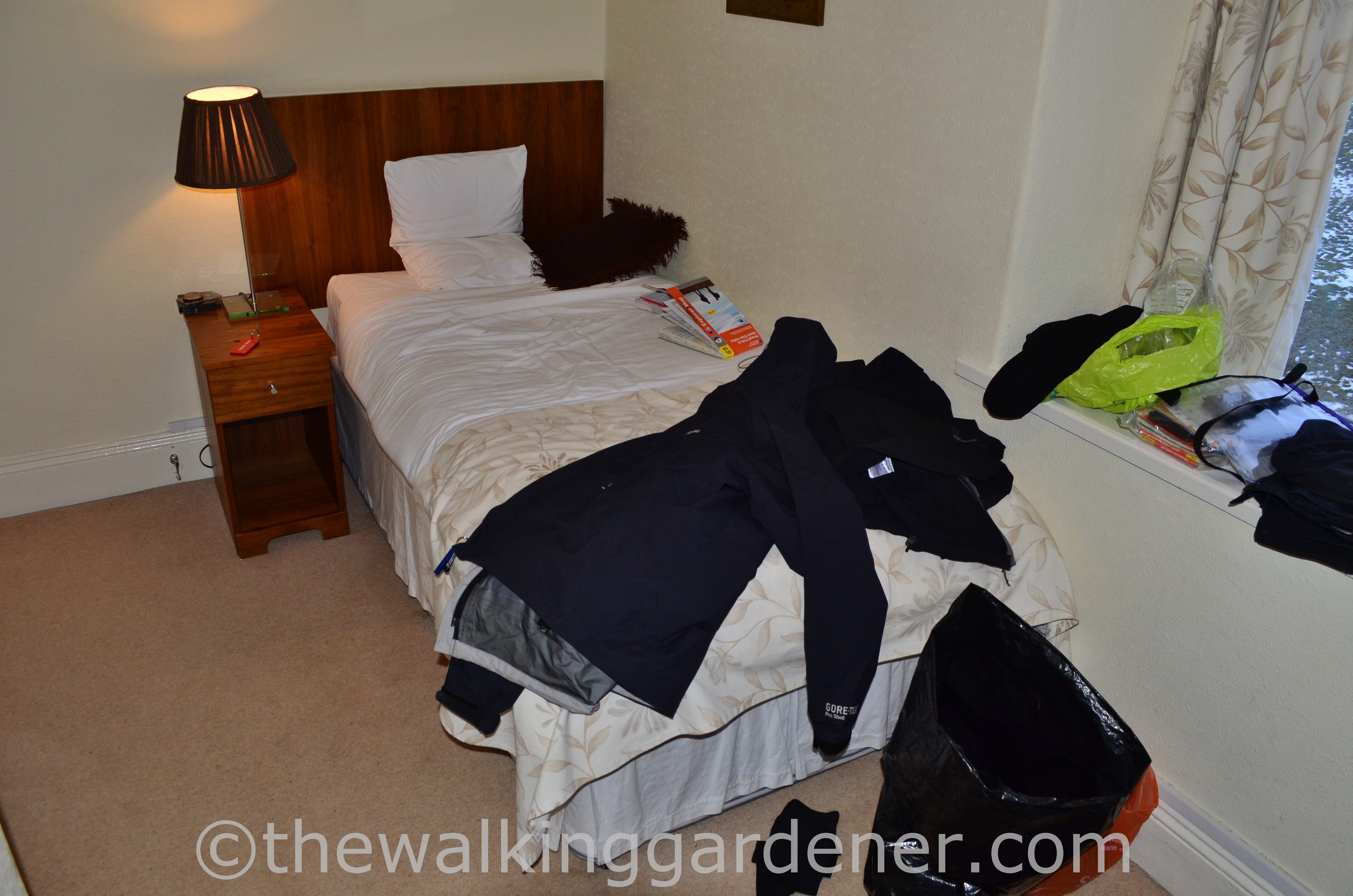
I was the only guest at the Lodge and their first Coast to Coaster of 2013. Matt said that including me, there was now a grand total of 19 people in Keld tonight. 19 people and 11 dogs.
Later, over good fish pie and several pints of excellent Black Sheep bitter, I chatted to Matt and a young couple who were staying in a yurt a couple of miles up the valley. Keld marks the half-way point on the C2C and I felt quite pleased with myself as I supped my beer and laughed in the bar. I had walked on six consecutive days and had six more to go. I planned an early night – as I still hadn’t had my rest day – but the company was great and the beer kept coming. It isn’t often that I enjoy a warm, relaxed evening amongst strangers but heck, I did that night in Keld.
Wainwright’s walk had already proved the most challenging and exhilarating of all my long distance walks. And oh, my word – the weather! March 2013 was the coldest since 1962: snow-drifts up to 20 feet deep were blocking roads, cutting off communities, closing schools and killing thousands of sheep across north-western Britain. My family and friends, worried at the scenes they were watching on TV, began to call or text asking if I was OK. Was I still alive even? Had I started out from St Bees just a few days later, the Lakeland passes would have been impassable, the walk impossible. Neither could I have passed through Keld. Four days later Matt emailed me – Keld had seven-foot drifts and 70 mph winds. I’d got through by the skin of my teeth.
I felt privileged and amazed, that I was able to continue, one step ahead of fearsome storms and snowdrifts, yet still in conditions that were exciting, a little dangerous and very beautiful to behold.
I didn’t want this walk to end.
 The Walking Gardener
Ah, Black Sheep, a fine beer! And you earnt it! Lovely smug feeling having braved such dramatic weather and walked on, if not regardless, at least with conviction. I’m already looking forward to where you walk next time.
LikeLike
Thanks Janet and yes! Black Sheep is a constant companion on my long walks up north.
LikeLike
On a pleasant September day it’s hard to fathom that such cold, wet, windy weather is even possible. Brr. What amazing countryside, though — I like that kind of wild and woolly landscape without a lot of trees getting in the way of… I was going to say the view. Sorry. Glad you had such pleasant company and good beer at the end there. Good dog-to-people ratio in Keld.
LikeLike
Hi Stacy, I didn’t mind the weather really. As nice as it is to stroll along in spring sunlight, snow and ice made it all the more er, interesting. I heard of an American couple who, having planned the walk for many years, did the entire path in fog and mist – no views whatsoever. The poor lady was in tears when they arrived at Robin Hood’s Bay. I guess, compared to that, I was very lucky. D
LikeLike